Student learning outcomes
Rooted in our commitment to peace, equity, and active faith, EMU doesn't just prepare you for a job; it equips you with the intercultural competence and ethical framework needed to become a co-author in the story of the world. Students graduate ready to live into their “why” and lead from and with their values as the north star. EMU’s general education complements a student’s chosen major- providing them with a broad preparation in leadership skills, systems understanding, and compassionate care for others. EMU’s brand of academic excellence elevates curiosity, creativity, and achievement of community-minded, lifelong learners.
EMU grounds general education in values.
Micah 6:8. What does the Lord require of you, but to do justice, love mercy, and to walk humbly with your God?
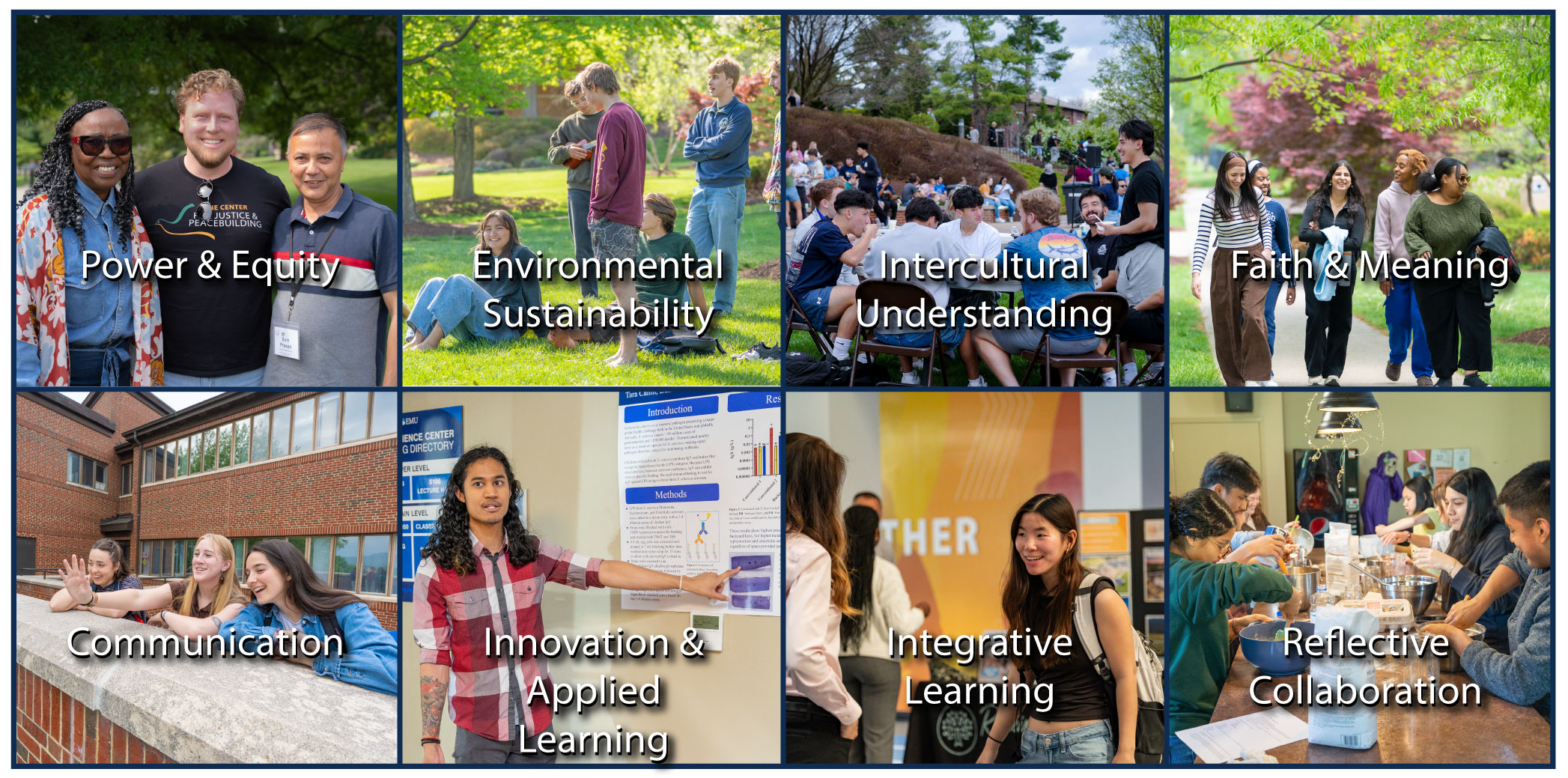
Power & Equity (Do Justice)
Students will analyze power and identity in systems and cultures through the lenses of anti-racism and anti-oppression to promote justice and equity.
Environmental Sustainability (Love Mercy)
Students will explain the significance of environmental sustainability and the interconnectedness between the natural world and human thriving.
Intercultural Understanding (Walk Humbly)
Students will demonstrate skills in cultural self-awareness and perspective-taking in intercultural contexts.
Faith & Meaning (With God)
Students will articulate their understanding of the meaning of their lives and the significance of their choices as a result of studying ethics, Christian scripture, and Anabaptist Mennonite beliefs in practice.
EMU provides practical, professional, social, and critical thinking skills that develop across the curriculum to prepare wise, engaged professionals and community builders.
Communication
Students will apply effective communication skills by gathering, interpreting, critiquing, and presenting information from diverse sources.
Exploratory and Adaptive Practice
Students will engage in artistic and quantitative practice, and will analyze and adapt to challenges and limitations.
Integrative learning
Students will synthesize knowledge from multiple disciplines to analyze complex issues that connect human culture, the natural world, and contemporary challenges.
Reflective Community Engagement
Students will reflect on their growth as persons in diverse communities, demonstrating curiosity about attitudes and beliefs and intentionally attending to conflict.
How do I know which pathway is right for me?
You’ll discern this through classes and conversations with faculty and staff during your first year at EMU.
EMU’s general education prepares you to be a wise, engaged professional and community builder. Across all pathways, you will build a high-demand toolkit for your career and your life:
-
Powerful Communication: Gather, critique, and present information effectively from diverse sources.
-
Adaptability & Innovation: Tackle quantitative and artistic challenges, learning to pivot and adapt to limitations.
-
Complex Problem-Solving: Synthesize knowledge from multiple disciplines to solve complex real-world issues.
-
Reflective Leadership: Learn to navigate diverse communities, stay curious about different beliefs, and intentionally resolve conflict.
Communication, Culture, and Creative Expression
This pathway is designed for students who want to:
- Describe different cultural and communal systems that frame one’s understanding of the world.
- Explain how various forms of communication have been used and continue to be used to shape culture, public discourse, and perspectives to make social, religious, and political change.
- Apply concepts of power and social structures to how meaning is shaped and communicated in various forms and different cultural contexts.
- Develop various skills ethically to communicate ideas with empathy and sensitivity to reach a broad audience.
This pathway is designed for students who want to develop skills in: intercultural curiosity, communicate ethically and with intercultural understanding and emphasis on justice, self-awareness regarding interpretative biases and power relationships, self-awareness on how symbols and representations function in personal and communal experience, ability to analyze cultural phenomena and meaning-making processes.
Technology, Ethics, and Society
This pathway is designed for students who want to:
- Understand and describe the framework of scientific inquiry and decision making.
- Identify different moral frameworks and apply ethical tools to scientific, technological and environmental dilemmas.
- Apply the dimensions of sustainability (economic, ecological, social) to specific cases or disciplines, and evaluate issues and outcomes of potential solutions.
- Develop skills to analyze and implement scientific ideas and technology ethically.
This pathway is designed for students who want to develop skills in: understanding of the language and values of science, understanding of science as it is applied in communities, understanding power and equity in the application of science, understanding processes of responding to scientific, technological, and environmental dilemmas through moral frameworks, ability to articulate questions and communicate ethical solutions to issues of sustainability in environment and technology.
Leadership for Justice and Social Change
This pathway is designed for students who want to:
- Understand different ways in which communities and movements use power, develop solidarity, and create justice.
- Describe and analyze how systems promote justice and positive change or allow inequities to persist.
- Explain how values and moral frameworks inform leadership choices both individually and within communities.
- Develop skills to reflect on leadership theories and practices that create communities of belonging.
This pathway is designed for students who want to develop skills in: respect for diversity and communities of belonging, leadership informed by empathy and desire for justice and equity, understanding how persons are shaped by various communities and structures, understanding systems of power and how structures can create disadvantages, promoting social change towards the common good, self-awareness of how one’s social location impacts leadership style and community dynamics.
Global Justice
This pathway is designed for students who want to:
- Describe historical and cultural dynamics that impact the emergence of and changes in communities and social structures.
- Understand various cultural perspectives on global justice topics, taking global views of contemporary issues across various geographic and social boundaries.
- Describe the interrelation of local contexts and global events, and identify different cultural moral frameworks that contribute to dilemmas as well as solutions to communal challenges.
- Develop various ethical skills to analyze perspectives and solutions for sustaining justice in interconnected communities.
This pathway is designed for students who want to develop skills in: intercultural curiosity, global view and understanding how local and glocal systems interconnect, work ethically and with intercultural understanding and emphasis on justice, self-awareness regarding interpretative biases and power relationships, ability to articulate questions and communicate just solutions to global issues.