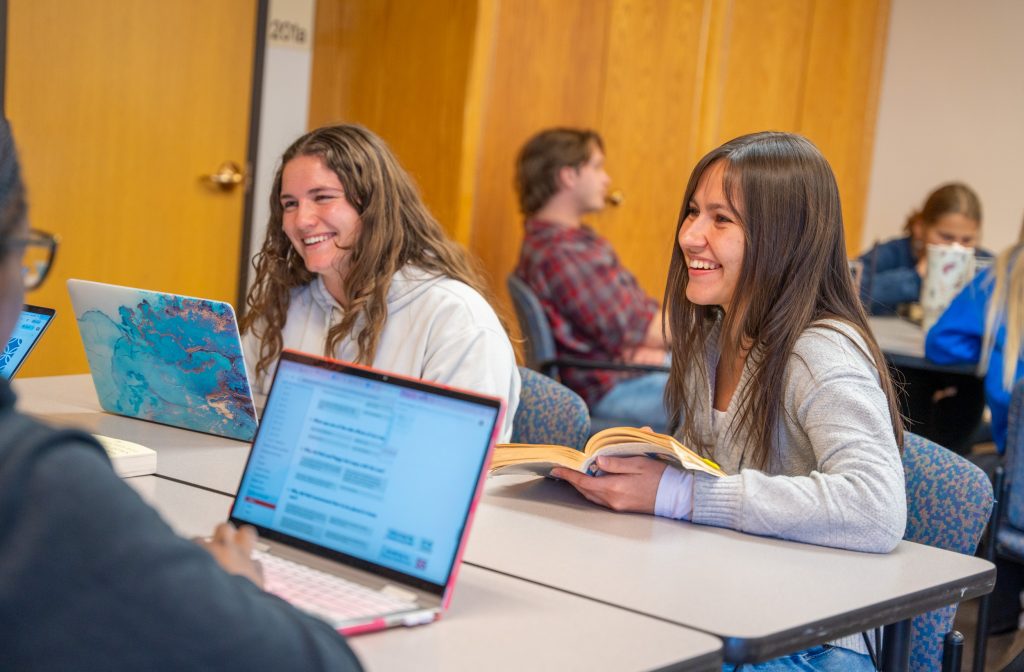
EMU nursing students get a glimpse from patients’ perspective through Family Partnership Project
You can always tell the difference between EMU nursing graduates and other nurses without asking them, says Kate Clark, associate professor of nursing at EMU.
“It’s what we hear all the time from hospitals and other employers, that there’s something special about EMU nurses in their approach to patients and their professionalism,” she said. “One major element is our family nursing class, which helps shape both their self-confidence and their cultural humility.”
That class, the semester-long Nursing & Family in Community course (NURS 426), partners undergraduate nursing students in pairs with refugee and immigrant families in Harrisonburg and Rockingham County. Students in the course, who are juniors and seniors midway through their clinicals, visit the families at their homes weekly to promote health education, help them navigate the U.S.’s complicated health system, and teach them basic essential skills to help them adjust to life in a new country.
These skills might include: navigating a phone tree to schedule a medical appointment, setting up taxi rides to appointments, using the bus system, enrolling in an employer-sponsored health insurance plan, and understanding the difference between primary care and the emergency room. Students have been known to ride Harrisonburg city buses with families, walk with them to a local food pantry, help read their mail, attend medical appointments with them, and connect them to community resources such as clothing closets and bicycles through the Bikes for Neighbors program (led by alum Ben Wyse ’99).
Students might tell families they can expect to see people in costumes walking around the neighborhood and knocking on their door for Halloween. They also might help families from warmer climates prepare for cold weather with appropriate winter clothing.
Students communicate with their assigned families using either their own foreign language skills or a provided interpreter. This semester, there are eight different languages spoken by families in the course’s Family Partnership Project.
Through the course, EMU nursing students build long-term therapeutic relationships with families, learn to provide care for a family unit, and experience the barriers that marginalized groups in the community face when trying to access health care.
“Because they get to experience those things from the family’s perspective, it gives them a good understanding of how the health system is not always designed for certain types of patients and the challenges they experience,” Clark said. “Whether or not they pursue home visiting long-term, it makes them better, more compassionate nurses across the board.”
She said the course sets EMU’s nursing program apart from others. “I’ve rarely heard of another school that has a standalone family nursing class that involves home visiting,” she said, “especially not one that focuses on refugee and immigrant families.”
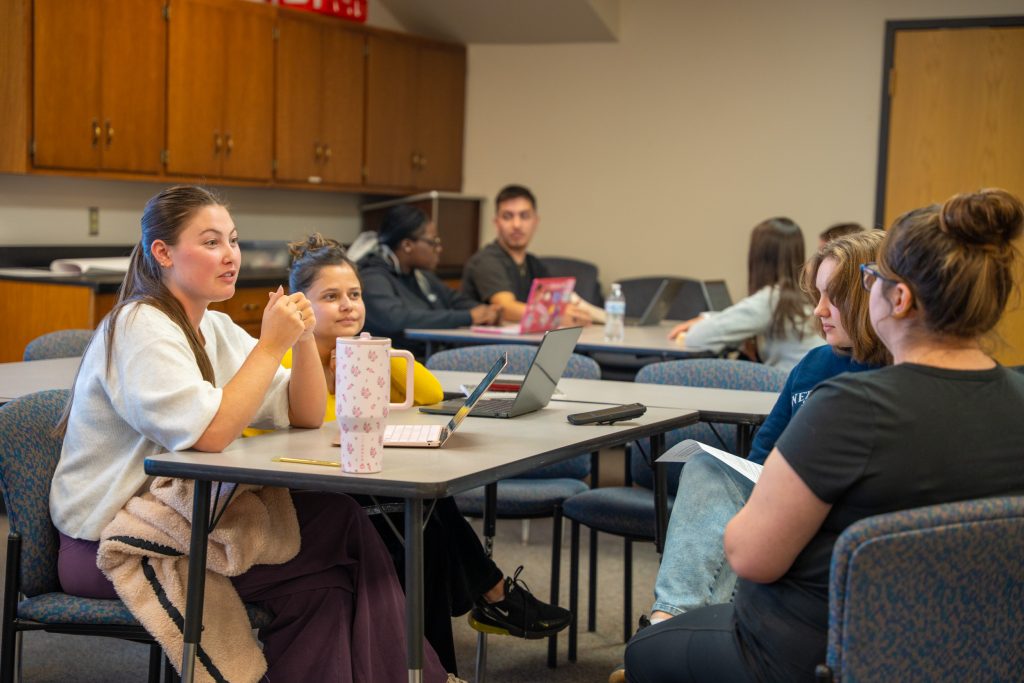
A ‘win win’
Many of the families participating in the Family Partnership Project have a tenuous grasp of English, are lower income, and need additional information to be able to navigate this new country. EMU’s nursing program partners with CWS Harrisonburg, a local office of Church World Service that serves and advocates for refugees, asylum seekers, unaccompanied children, and immigrants in the Shenandoah Valley. The agency identifies local families in need who can benefit from the project’s tailored support, resource referral, and health teaching. The students’ help is invaluable, especially at a time when policies enacted by the current presidential administration have led to funding and staffing constraints for the organization.
“We’re grateful for EMU’s nursing program,” said Susannah Lepley, Virginia director of Church World Service. “I like programs that are a win win for both the university and the families and this is definitely one of those. The students get a lot out of it, the families get a lot out of it, and I think it’s a strong selling point for EMU.”
In the past, students have worked with families who have been in the U.S. for only one to two months. This semester, due to fewer refugees entering the country, nursing students are working with families who have been in the U.S. for a year or more. This has allowed them to focus on longer-term concerns such as nutrition, stress management, and mental health.
“You can’t overstate the friendship aspect,” Lepley said. “People often leave a pretty intense network of support back home and they come here and they don’t have that anymore. They have to recreate it from scratch and I think the nursing students are a big part of that.”
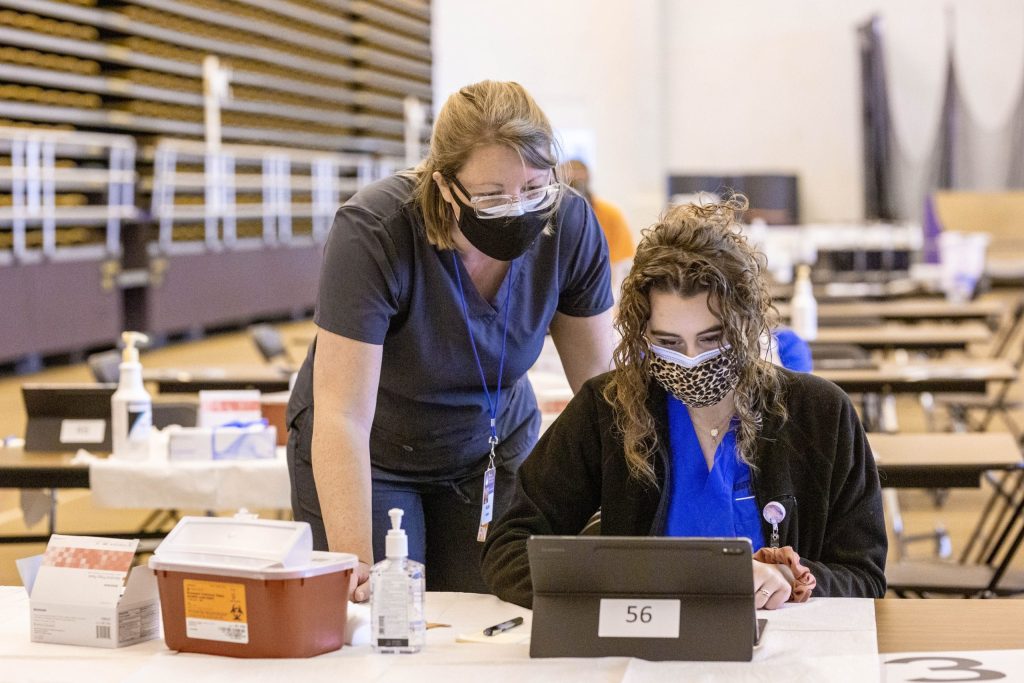
The epitome of EMU nursing
Clark, who has taught the family nursing class for the past 13 years, graduated from EMU with a BSN in 2007. She took the course as a student under longtime professor and mentor Ann Graber Hershberger ’76. During her semester in the course, Clark was paired with a Spanish-speaking single mom in Timberville.
Up until that course, Clark had questioned whether she actually wanted to become a nurse. She felt like there was never enough time during her clinicals at the hospital and that she was just checking boxes.
“I knew I wanted to do something with a bigger impact, and when I took that class, I felt like I could finally let out the breath I had been holding since I started the nursing program,” she said. “I don’t know if I would’ve stayed in nursing had it not been for my experiences in that class.”
Another alumna from that year, Rebekah Good Charles ’07, said the class prepared her well for the work she now does as a community health nurse serving families around Lancaster, Pennsylvania. During her semester in the course, she visited with an immigrant family from Mexico and helped them sort through medical bills, contact financial aid, and fill out paperwork.
“It was interesting to see the health care system from that side,” Charles said. “You can do all these things for your patients when they’re at the hospital, but when they get home, they’re left with all these loose ends to tie up. It was eye-opening to see that and help someone work through that, and it made me realize just how complicated the health system can be.”
Lydia Tissue Harnish ’17, MSN ’23, uses the same skills she acquired from the family nursing class in her job as a maternity educator for the Lancaster Nurse-Family Partnership. During her senior year at EMU, she was paired with a refugee family in Bridgewater expecting a second child. Harnish spent the semester preparing the family for what the birthing experience in the U.S. would be like.
“It’s really the epitome of EMU nursing,” she said. “We’re in the patients’ home setting, assessing the whole person, their environment, and their family as a whole.”
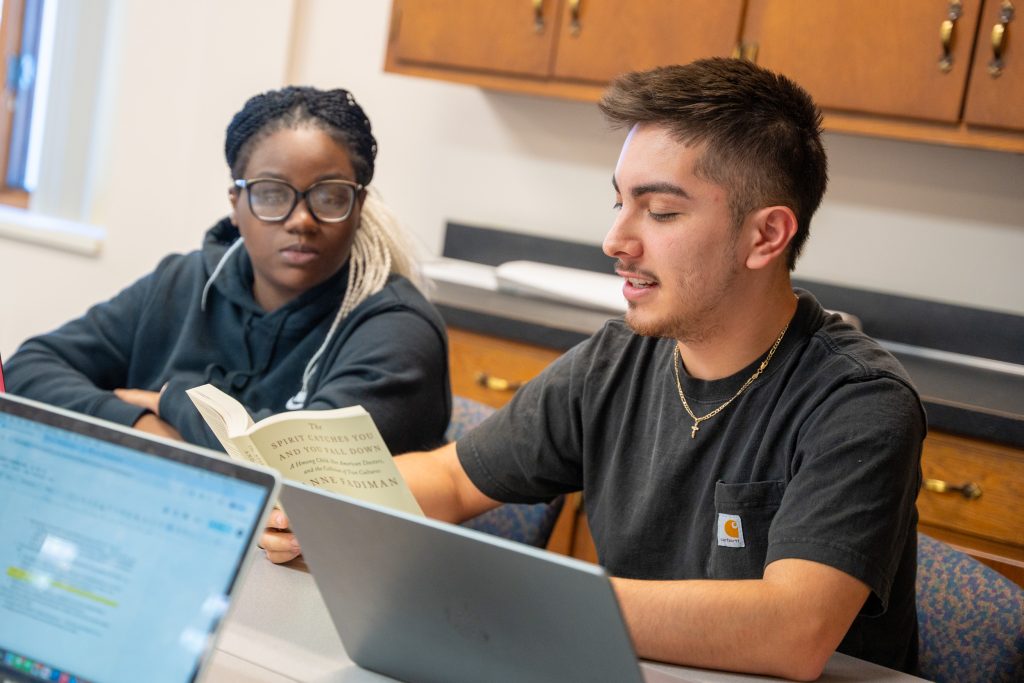
‘Begin to thrive’
When senior nursing major Joshua Stucky and another EMU nursing student met with a Syrian refugee family for the first time in January, only a month after they had arrived in the U.S., he felt overwhelmed at the prospect of helping with their cultural transition.
“They didn’t know how to use their phones or get their kids to school and didn’t have a way to get around,” he said. “And so I walked out of that first meeting thinking, How are we ever going to help this family? … You eventually have to set an expectation that you’re not going to solve all their problems.”
Over the course of the semester together, the pair of students was able to solve some of them. Through a connection he had with Bikes for Neighbors, they were able to provide the family with bicycles. They were also able to ensure the children received the vaccines they needed and that the family had access to a neighbor’s car.
During one of their final home visits with the family, while talking to the parents, he remembers seeing the two younger children bound into the home with their backpacks. “They had been going to school and, even though we didn’t play a huge role in that, it was just the most rewarding thing to watch them begin to thrive,” Stucky said.
| Did you know? • At EMU, students can earn a bachelor of science in nursing (BSN), a master of science in nursing (MSN), and a doctor of nursing practice (DNP), as well as graduate certificates in nursing. Through EMU’s accelerated second degree program, adults who already have a bachelor’s degree can complete a BSN in 15 months. • 90% of EMU nursing graduates in 2023 passed the NCLEX-RN, the standardized test required to earn a nursing license. • 55% of EMU nursing graduates over the past five years reported their first job after graduation as being in the local and surrounding area. |
Learn more about EMU’s nursing program at emu.edu/nursing.
Join the Discussion on “Family nursing class a ‘win win’ for students and refugee families”