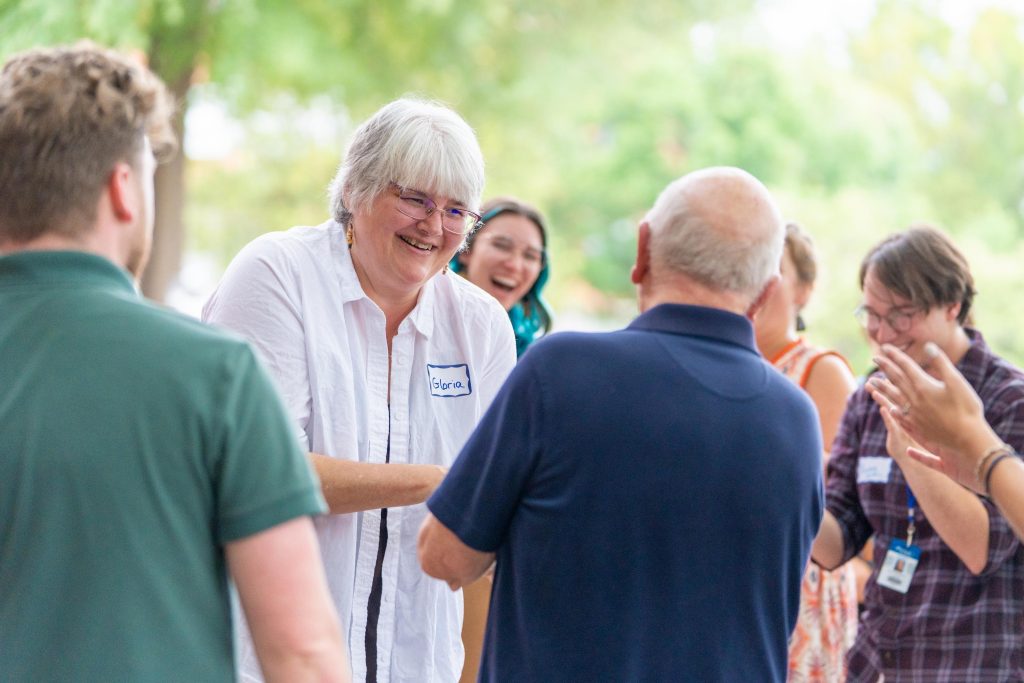
The classroom was packed. Over two-dozen people crowded into seats. Some stood along the sides. Others sat in the aisles. Only a few years after earning an English degree from EMU, Dr. Gloria Rhodes ’88 was in Russia helping establish an intercultural program. She stood at the front of the room, leading a Bible study on the Mennonite peace tradition.
Born and raised in the Mennonite church, Rhodes grew up believing she was called to be a peacemaker. But that early understanding of peace, she admits, made her avoid conflict rather than engage in it.
Then, two students, burly Russian men seated near the back of the classroom, began arguing.
Within moments, the tension shifted. Chairs scraped. Voices sharpened. The exchange turned physical. And Rhodes realized something that would change the course of her life.
“I could talk about peace, but I didn’t actually know how to respond when presented with conflict,” she said. “When I returned to the United States, I knew I needed to learn how to handle conflict.”
She scuttled her previous plans to pursue a graduate degree in English and instead studied conflict analysis and resolution at George Mason University, earning both a master’s degree and a PhD. While at graduate school, she was hired by Professor Emeritus Dr. Vernon Jantzi ’64 to help coordinate the newly launched Summer Peacebuilding Institute (SPI) at EMU.
For 34 years, Rhodes has taught at EMU, primarily in its world-renowned Center for Justice and Peacebuilding (CJP). Today, she serves as academic director of CJP and professor of peacebuilding and conflict studies. She also teaches courses in conflict transformation and peacebuilding for the undergraduate program and the master of nursing program.
Rhodes has led semester and summer intercultural programs in Northern Ireland, the Republic of Ireland, Russia, South Korea, and the Navajo Nation. She has served as department chair of EMU’s Applied Social Science Department, administrative director of SPI, and as a program assistant for the National Conference on Peacemaking and Conflict Resolution.
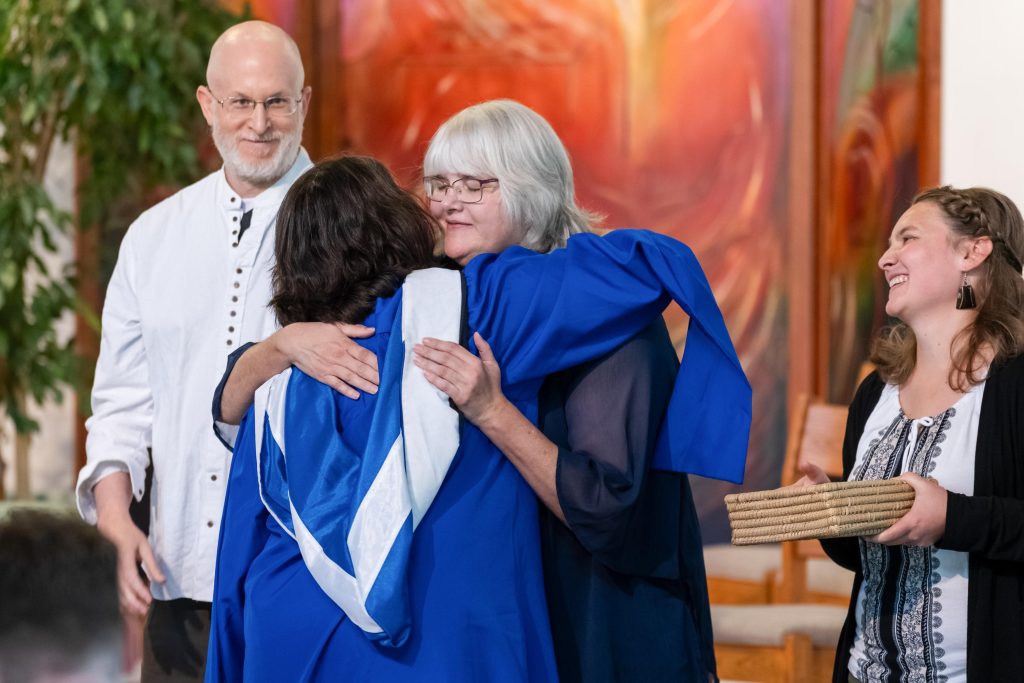
With SPI turning 30 this year, we sat down with the long-tenured professor to talk about the values-based education offered at CJP and how students are bringing more peace and justice to the world.
The following responses are from an interview that Rhodes conducted with photographer and videographer Macson McGuigan ’17. A video from their interview will publish later this spring. These responses were edited for conciseness.
What’s unique about CJP?
Many other programs teach basic communication or mediation skills, but what we add at EMU goes deeper. Our focus is on who you are and what you bring. Beyond the technical skills of conflict transformation, students engage in deep reflection and introspection around questions of:
- Who am I?
- What are my values and identities?
- What do I uniquely contribute to this work?
- And where do I fit in creating a more just and peaceful world?
We challenge students to connect their personal growth with leadership. They consider how to bring these skills and values into the places where they already work and lead. That combination of skill and self-assessment is the value we offer.
What can CJP grads do with their degrees?
There are generally three directions our students take. About a third go into direct practice, often working with nonprofit or non-governmental organizations anywhere in the world. These roles can include mediation centers, community outreach, or other supporting positions where they apply skills like facilitating discussions and bringing together diverse groups to meet community needs.
Another third pursue further education. Many go on to doctoral programs to study conflict more deeply, contribute to policy, or prepare to teach in this relatively new field.
The final third continue in their current careers in positions ranging from ministry, health care, business, and government. They’re drawn to CJP because they want to improve how people work together, make decisions, and solve complex problems.
Why should people study at CJP?
We are truly about creating a learning community together. This isn’t a place where you come to be filled up with knowledge. You come because you want to explore your part in making the world more peaceful, and together, we figure out how to bring more peace and justice to the world.
We can’t do it alone, and no single set of skills fits every situation. That’s why our approach is based on mutuality and learning, where everyone’s experiences and knowledge matter. Students contribute what they know, and at the same time, gain practical skills they can use in their own contexts.
Our focus is on practice, not just theory or research. We care about what people can do to make the world more peaceful and just. CJP is a place to learn, share, and build that future together.
What kinds of hands-on experience is offered at CJP?
Our curriculum is intentionally designed to include hands-on practice in the community. For example, in the facilitation course, our graduate students are contracted by local groups and organizations to help facilitate meetings or support decision-making processes. While students are learning and practicing new skills, the organizations also benefit from their work.
At the end of the master’s program, students can choose a traditional thesis, but most complete a practicum. These opportunities are diverse, ranging from restorative justice and trauma healing to mediation, facilitation, and training. Alumni often connect current students with new practice opportunities, ensuring a rich network of real-world engagement.
What is the Summer Peacebuilding Institute (SPI)?
Part of how we support our students is by offering courses in the summer, not as traditional summer school, but as a training institute. These courses and trainings, held in May and June, allow anyone to explore topics related to conflict, restorative justice, and other areas of practice. Courses generally last five to seven days, and multiple courses run simultaneously over the two-month period.
SPI is intentionally designed as a learning community. Students live in dorms, attend classes and lectures, and learn from one another, all while experiencing what it means to live together in a diverse community. It’s both a retreat and a training space. As one alum described, SPI is like a well where people can take a drink of water. It’s not going to feed them forever, but it’s nourishment they can take back into their work and communities.
Thanks, Gloria. A great description of what makes CJP special and the unique experience of SPI.