This article originally appeared in the March 26 issue of The Weather Vane. To read more articles like it, visit theweathervane.org.
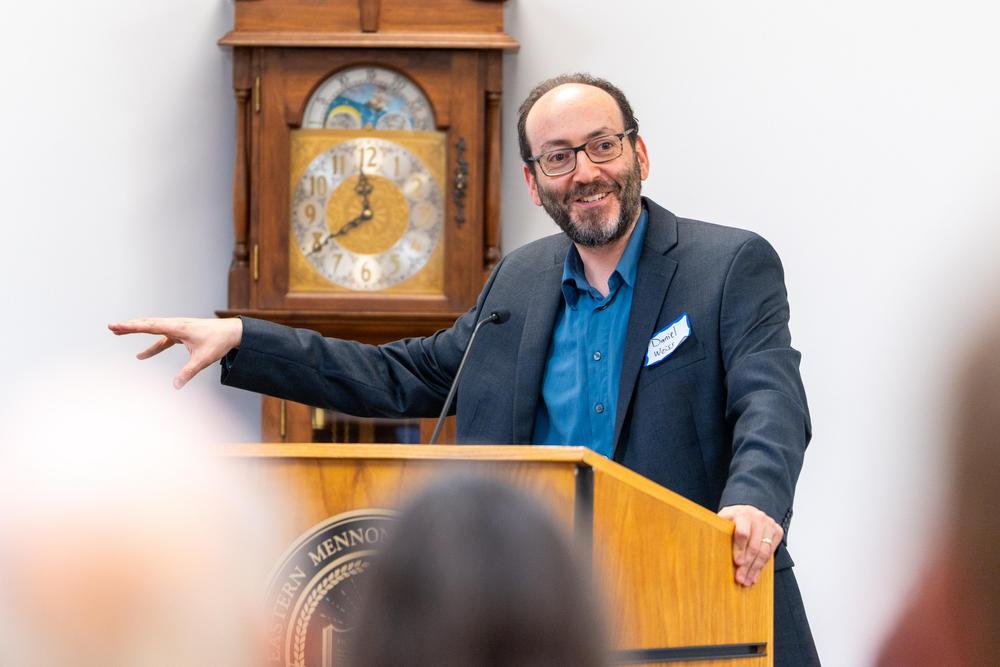
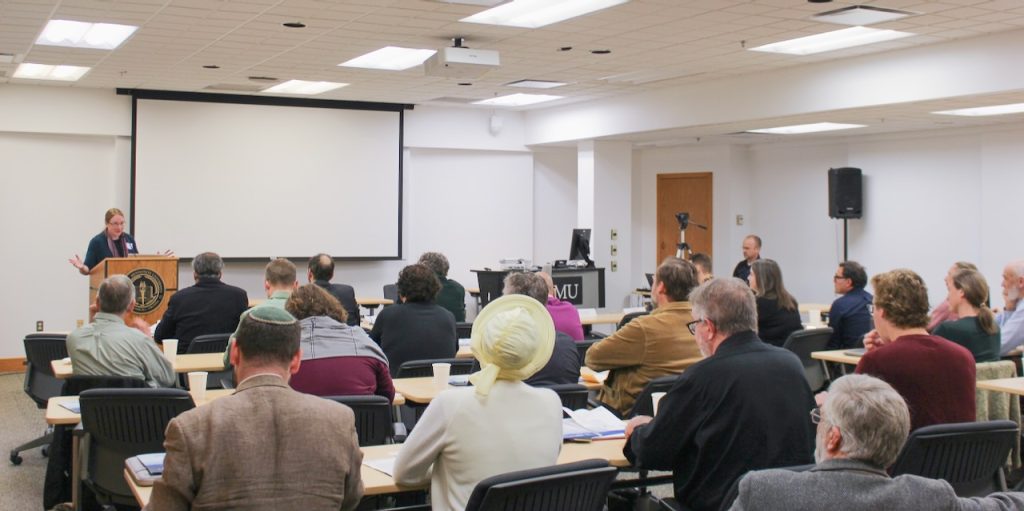
On Monday, March 23, Anabaptist and Jewish scholars and religious leaders gathered in the Strite Conference Room of EMU’s Campus Center for a consultation on Judaism, the Bible, and Anabaptism. The invite-only event was planned by Peter Dula, professor of religion and culture at EMU, and Trina Trotter Nussbaum, director of the Center for Interfaith Engagement (CIE), and included all-day discussions centering around the work of Matthew Thiessen and Daniel Weiss.
According to Dula, Thiessen, a Mennonite New Testament professor at McMaster University, is “one of the most influential voices in the ‘Paul within Judaism’ school of New Testament studies.” The discussion of Thiessen’s work at the consultation centered around four articles of his.
Weiss, according to Dula, is a Jewish professor of Jewish studies and the philosophy of religion at the University of Cambridge, “whose work at the intersection of early rabbinic literature and early Christian literature has significant resonances with traditional Anabaptist understandings of violence and the state and critiques of Constantinianism.” Weiss also had four articles discussed.
The morning began with a presentation by Thiessen titled, “What Mennonites Need to Know About Judaism,” which introduced the work of Weiss. Weiss then responded, and there was time for some questions from the audience. Following a break, a panel engaged with some of Weiss’s research, including articles on Christians and Levites, and the possibility that early Christians did not baptize their children, instead letting them be born into salvation.
After a lunch break, Weiss took a turn introducing Thiessen’s work in a section called, “Reading the New Testament within Judaism.” Thiessen then responded. A panel then engaged in Thiessen’s work, including reflections on how to read Paul with an awareness of Judaism, and whether Jesus meant to start a new religion.
Dula was the guiding force in bringing the two scholars together to have the event. “You’ve got a Jewish scholar writing really perceptively about Anabaptist themes, and you have this Mennonite scholar writing really perceptively about Judaism,” Dula said. “So, I thought we should get them together.”
Nussbaum reflected on the efficacy of the dialogue, and how it was in large part also due to the highlighted speakers. “It worked because the two scholars we were highlighting shared the spotlight so well,” she said. “How many times did we hear, ‘and now I want to open it up to you all?’”
Miranda Beidler, an EMU senior who helped coordinate the event in her role as a student chaplain with the CIE, praised the event and guests for creating “inherent dialogue.” She said, “[The speakers] were so willing and open to talk about their beliefs, their theology, in ways that were open and curious about the others’ theology and beliefs, but without imposing their beliefs on somebody else.”
Sara Kennel, another senior student chaplain at EMU, was struck by the openness and intellectualism of the event participants, saying, “It felt like a gathering of a lot of people that care about understanding differences, but also are deeply intellectual. … I don’t think that I’ve encountered that many spaces at EMU that are that level of scholarship.”
Nussbaum was struck by the impact of cross-religious dialogue, saying, “It’s something pretty amazing that we can see ourselves in another faith. … It was a spiritual love-fest.” Beidler, similarly, connected the event to CIE’s—and EMU’s—goals of interfaith work, saying, “It’s us putting into action when we say we care about learning from other people and from other cultures.”
Join the Discussion on “EMU hosts consultation on Judaism, the Bible, and Anabaptism”