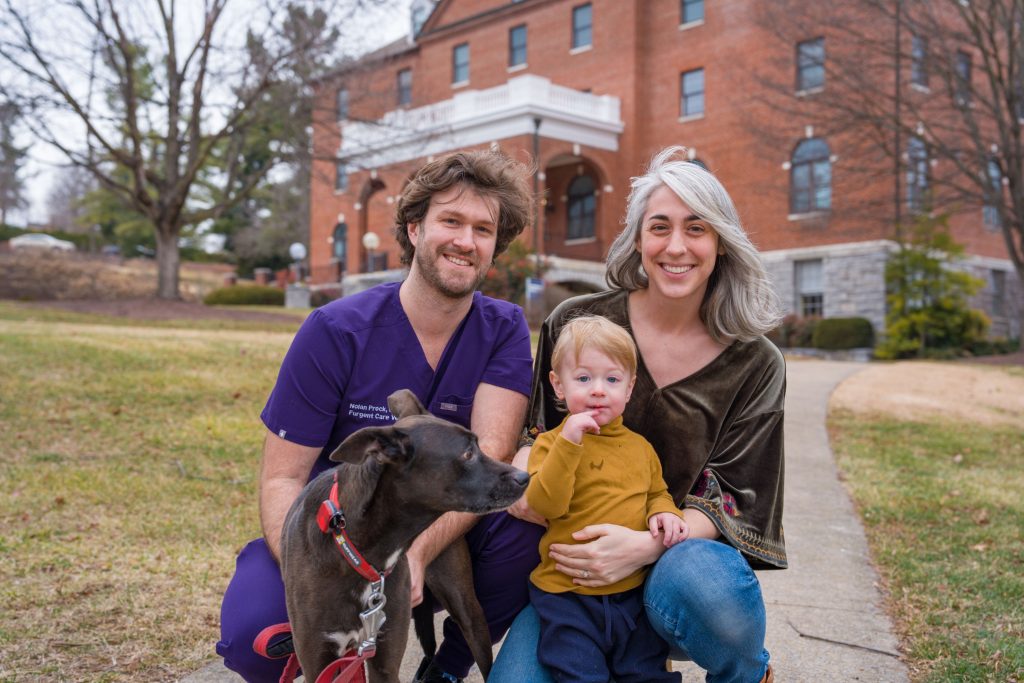
Veterinarian Nolan Prock ’12 remembers one of his earliest patients. It was a frog. And Prock, a biology major in the Pre-Professional Health Sciences (PPHS) program at EMU, was tasked with anesthetizing and operating on the amphibian to remove its oocytes (egg cells that haven’t fully matured yet).
“I got to practice incisions and suturing, and we had some frogs that needed postoperative care,” he said. “That was a really valuable experience, and I don’t think I would’ve gotten that at a lot of other schools.”
These days, Prock doesn’t operate on frogs. His patients are mostly dogs and cats. The vet is the co-founder of Furgent Care, a veterinary urgent care in Virginia Beach that offers evening and weekend services for pet owners when their primary care veterinarian is unavailable.
Identifying a need
In 2018, following four tough years at veterinary school (Virginia-Maryland College of Veterinary Medicine at Virginia Tech), Prock earned his doctor of veterinary medicine degree. After working as a general practice vet at a clinic in South Florida for three years, he returned to his hometown of Virginia Beach with his wife, Katie (Landis) Prock ’12—they met at EMU—and worked as a locum, filling in for understaffed hospitals that needed help.
“Think of it like substitute teaching, but for veterinarians,” Prock said.
That experience opened his eyes to the growing need for after-hours veterinary services.
“It shocked me the amount of clients who would call in with sick pets and say, ‘My dog is vomiting or has diarrhea or has an ear infection,’” said Prock. “And the answer was, ‘Our first available appointment is in two weeks.’ That’s just how the system works. But it felt wrong to say no to so many sick pets.”
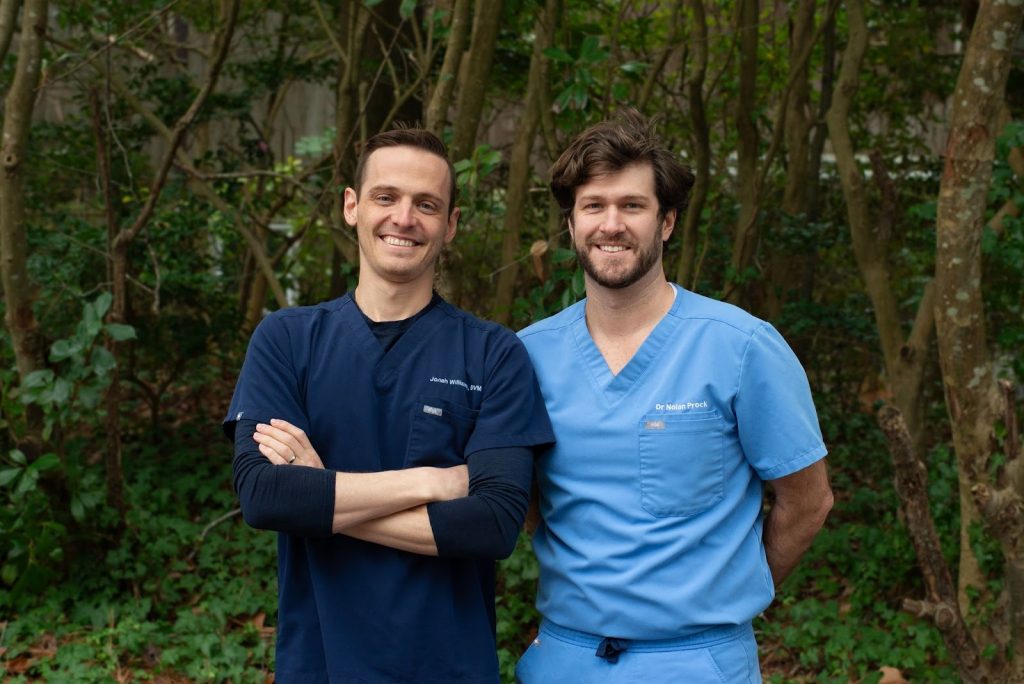
That motivated him to reach out to his roommate from vet school, Jonah Williams, and together they opened Furgent Care in 2024. The clinic is staffed by 16 total employees, including four doctors. It has 164 reviews and a 4.9-out-of-5 rating.
“Our core values are compassion and collaboration, and that’s been echoed in our reviews,” Prock said. “People get what we’re doing and they appreciate it.”
Seeking a balance
From a young age, Prock had a love for animals. He said he’s always known he wanted to become a veterinarian.
“My parents let us keep weird pets,” he said. “I had all sorts of reptiles growing up, hedgehogs, guinea pigs, and bunnies. You name it, we took care of it.”
That taught him the responsibility of pet ownership and fostered in him a connection to animals. He added that he’s also always been fascinated with the subject of biology, the natural sciences, and the “huge, complex system that makes all living things, living things.”
Those interests coincided with a passion for volleyball. A skilled player in high school, he started attracting attention from college recruiters across the country.
His older sister played volleyball at a Division I school, and he saw the commitment required to compete at that level. “I got to see firsthand what having, essentially, a full-time job on top of college looked like,” Prock said. “That helped steer me toward Division III and EMU.”
“From my visit to EMU, I felt like I could achieve a balance: smaller class sizes and professors who were involved and cared for their students more than they could in a thousand-student lecture hall,” he said. “As an athlete, I was given some flexibility with my assignments. They understood I had more than just school going on and helped me outside of class when I missed it.”
“I think that balance made a huge impact on my ability to eventually get into vet school,” he added.
At EMU, Prock excelled as a student-athlete. He was named to the first-ever Continental Volleyball Conference All-East Division Team during the inaugural season of the conference. His name still ranks No. 2 on the all-time digs list for EMU.
Although no amount of work can truly prepare someone for the rigors and stressors of vet school, he said, EMU’s coursework and degree equipped him as best it could. “It was absolutely difficult and was a new level of challenging, but as far as fundamentals go, I had everything I needed,” he said.
It’s also incredibly difficult to get accepted into vet school, he added. After graduating from EMU with a biology degree, he stayed in Harrisonburg for a couple years, working as an assistant at Heartland Veterinary Clinic and serving as an assistant coach for the men’s volleyball team at EMU. At the same time, he applied to a flurry of veterinary schools across the country.
“I tell people I took one year off on purpose and one year off by accident, because I didn’t get into veterinary school,” said Prock. He was eventually accepted during a second round of applications.
When he started vet school, he had three goals. One was to graduate. Another was to stay married. And a third goal was to get as much sleep as he could. “My priorities looked different than most people’s,” Prock said, noting the hypercompetitive nature of vet school students. “It was never my goal to become the world’s best veterinarian or the world’s best clinician. I always wanted to help people and I knew I could do that by helping pets and working with animals.”
Keeping his passion going
One of his most meaningful experiences from his time at EMU occurred during a senior seminar class taught by Professor Emeritus Roman Miller. Prock recalled an assignment to shadow a large-animal veterinarian at cattle farms around Harrisonburg for several weeks. They performed everything from routine pregnancy checks to emergency calls and surgery.
“That was wonderful preparation,” Prock said. “I gained an immense amount of respect for farmers and for large-animal vets who work incredibly long and hard hours. To have that kind of foresight in making me do that was really wise and paid off in keeping my passion going.”
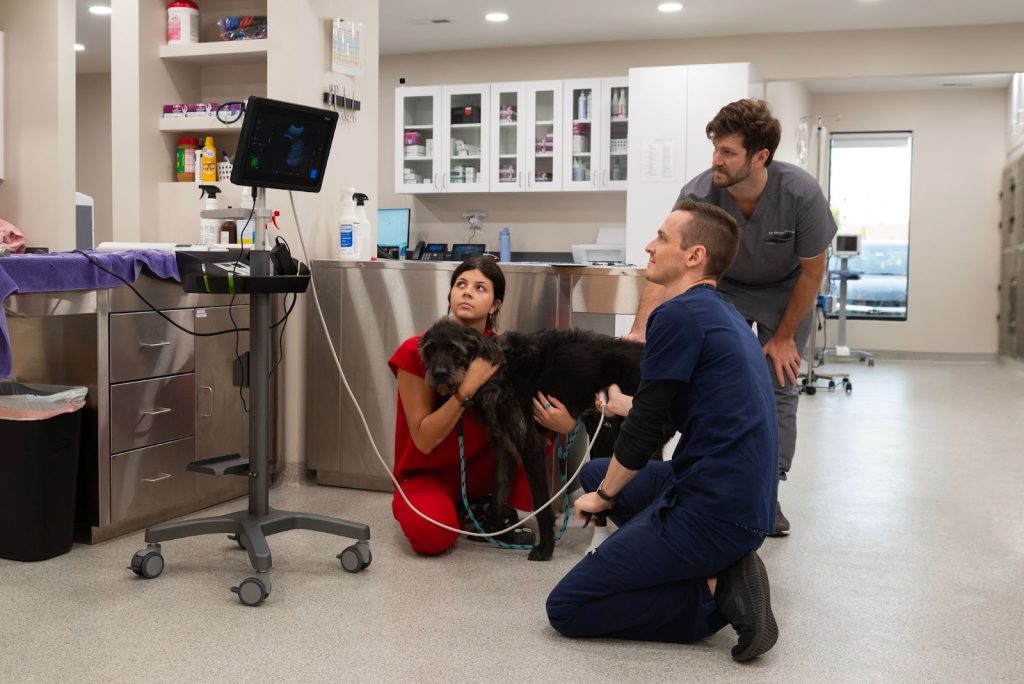
As Prock’s responsibilities at the clinic have shifted, he’s spent more time on the business side, building teams and systems, and less time on the floor seeing patients.
For those like him, seeking a career in veterinary medicine, he said the role requires a “specific type of brain.”
“It’s common to find people who have a passion for animals,” he said. “It’s less common to find those who have a passion for helping people, solving problems, and working with teams.”
Learn more about the clinic at furgentcarevet.com.
Join the Discussion on “Volleyballer-turned-veterinarian Prock ’12 helps people through their pets”