SMALL PRIVATE COLLEGES AND UNIVERSITIES face daunting challenges in today’s ever-evolving world of higher education.
The demographic cliff—a drop-off in the number of high school seniors—is resulting in fewer applicants and lower enrollments. Rising costs, coupled with shrinking revenues from those lower enrollments and modest endowment sizes, are forcing many schools to close their doors. And a growing skepticism about the return on investment of a private college education is leading more prospective students to turn elsewhere.
Some of those students are flocking to alternatives to the traditional four-year college degree, opting instead for trade schools—where enrollment has surged since the pandemic—or on-the-job training programs right out of high school. Others are taking advantage of the flexibility and accessibility offered through online programs and earning a degree without stepping foot on a campus. Still, many prospective students are forgoing higher education altogether, and in droves. According to the National Center for Education Statistics, the proportion of high school graduates going straight to college has fallen from a peak of 70% in 2016 to 62% in 2022 (the most recent year on file).
For students still planning to go to college, the larger and more popular schools offer a sense of security—a promise that their investment will pay off. In a crowded and hypercompetitive market, it’s often the name on the diploma that speaks the loudest. “As a result, every private college needs to adapt, not just to survive, but to better serve the needs of its students and society,” said Braydon Hoover ’11, MAOL ’21, vice president for enrollment.
In response to these looming existential threats, EMU is taking bold steps to ensure its mission and community thrive for generations to come. University leaders have spent the past year strategically planning a path forward, known as Reimagining EMU, that directly addresses these challenges and sets a vision for the future. That plan includes steps to optimize the school’s resources, reconfigure its academic structure, increase brand awareness, and invest in innovative solutions that differentiate the university and its students.
A curriculum that counts
One of the most exciting developments to emerge from the Reimagining EMU process is the new pathways curriculum projected to roll out beginning in the Fall 2026 semester. This innovative, interdisciplinary framework repackages EMU’s general education/core curriculum into four focused pathways, each aligned with university values. These pathways are both transcriptable and translatable, designed to clearly communicate relevant skills to employers.
The pathways curriculum promotes the university’s strengths and values while helping students develop in-demand soft skills that enhance their career readiness in a competitive job market. Students will likely select a pathway in the second semester of their first year, with guidance provided to help them choose the option that best fits their goals.
“This new model can be tailored to each student’s unique abilities and interests, adapts to a variety of careers, and ensures their general education credits truly count, all at no additional time or cost to them,” said Dr. Tynisha Willingham, provost and vice president of academic affairs.
Divisions and deans
Another way that EMU is positioning itself to better serve its students and fulfill its mission is by reconfiguring its academic structure from three schools to two divisions. The new leadership structure will help the university work more efficiently and encourage greater integration and collaboration across academic programs.
Two deans with extensive leadership and grant management experience have been appointed to lead the academic divisions, with both officially beginning their roles on July 1, 2025. The Rev. Dr. Sarah Ann Bixler ’02, former associate dean of Eastern Mennonite Seminary, serves as dean for the Humanities, Arts, and Social Sciences division. Dr. Michael Horst ’12, MAC ’14, former interim associate dean, former director of EMU’s counseling program, and current director of its psychology program, serves as dean for the Health, Behavioral, and Natural Sciences division. The two divisional deans work closely with Dr. Tara Kishbaugh, inaugural dean of faculty and student success, and Jonathan Swartz MA ’14 (conflict transformation and MDiv), dean of students, while reporting to the provost.
“These appointments mark an important step in EMU’s reorganization and will help the university better serve students and live out its mission,” said Willingham. “We feel invigorated by having leaders of this caliber stepping into these roles. Each brings a deep commitment to student success, faculty development, and collaborative leadership as we fully embrace and live into this new structure.”
Streamlined for students
As part of the reimagining process, EMU is focusing on what it does best while adapting to the changing needs of today’s students. Over the past year, faculty and staff worked together to streamline course offerings, making them easier to navigate and more clearly connected to career outcomes, without losing the unique character of the EMU experience.
That includes phasing out programs with little to no current enrollment, few graduates in recent years, and limited interest from prospective students. Beginning in fall 2025, the university will no longer offer chemistry, economics, history, health and physical education, or writing studies as standalone majors. Students will still be able to engage with the values and ideas of these disciplines through minors and as part of the new pathways curriculum. Additionally, EMU is introducing a criminology major (designed around the principles of restorative justice) and a finance minor to better align with student interest and career opportunities.
“These majors reflect growing interest from prospective students and respond to workforce needs both locally and nationally, while staying rooted in our mission as a peace and justice university,” Willingham said.
Turning the corner
Hope is already shining brightly at EMU. Alumni, friends, and donors are showing their strong support for EMU, giving at record levels. This year’s LovEMU Giving Day brought in a record-breaking $365,313, helping make the most recent fiscal year the university’s second-highest fundraising year in the past three decades. The university has already raised more than 60% of its $40 million goal for Forward Together: Preparing Tomorrow’s Unifying Leaders (2023-2028), the largest fundraising campaign in EMU’s history.
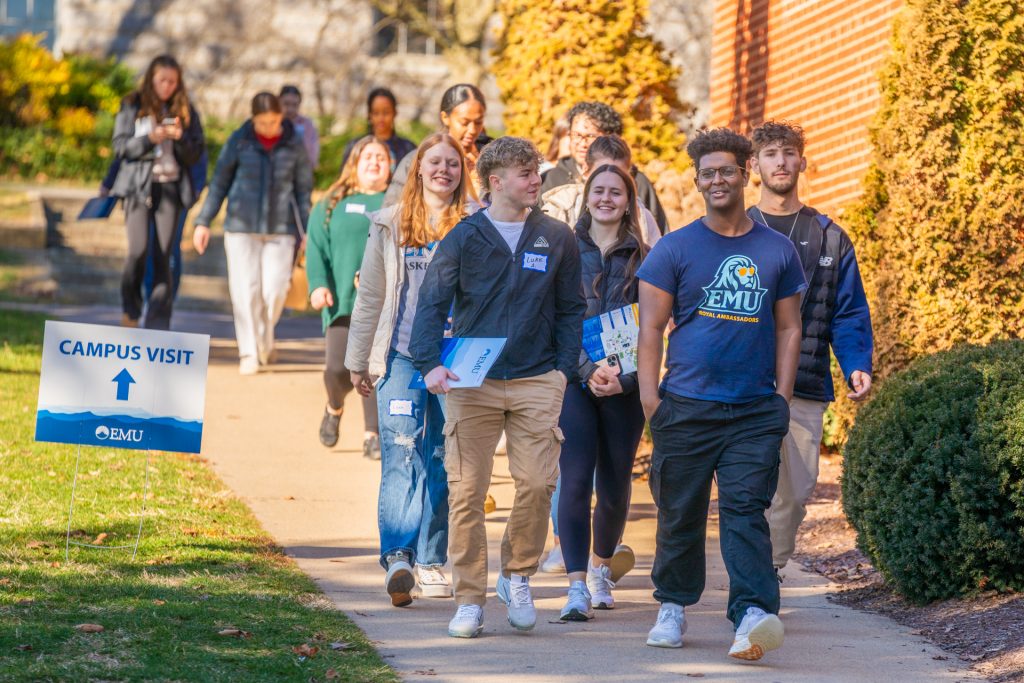
Another source of optimism on campus comes from EMU’s dedicated admissions team and the enrollment numbers for the incoming Class of 2029. As of the 2025 Census, following the close of the 10th day of classes, this year’s incoming class is up 10% over last year and almost 2% higher than the year before.
“This encouraging momentum is a testament not only to the hard work and heart of our enrollment team, but also to the collective efforts of faculty, staff, and the entire EMU community,” Hoover said. “Their dedication to building relationships, telling EMU’s story with integrity, and walking alongside students in their discernment is making a difference. We’re seeing stronger engagement and deeper alignment between who we are and who we’re meant to serve, and that gives me great hope for EMU’s future.”
New leadership
As the Rev. Dr. Shannon W. Dycus settles into her role as interim president, she is focused on continuing the reimagining process to guide the university toward sustained success. Dycus, who took office on July 1, 2025, succeeds President Emerita Dr. Susan Schultz Huxman, who announced last fall she would be retiring after nine years as EMU’s ninth president. Dycus has led student affairs at EMU since 2019 and brings a deep passion for the campus community and its students. “We will continue to reimagine what EMU looks like and who it serves, in ways that are both surprising and exciting,” she said.
This story appears in the Summer 2025 issue of Crossroads magazine.
Thanks for this update Brandon. I pleased to see the enrollment increase in light of the competitive landscape, but sorry to see the Economics major dropped, but understand. I’m glad to see the finance minor being offered. Is the MBA program at the graduate level continuing? Thanks. – Allon