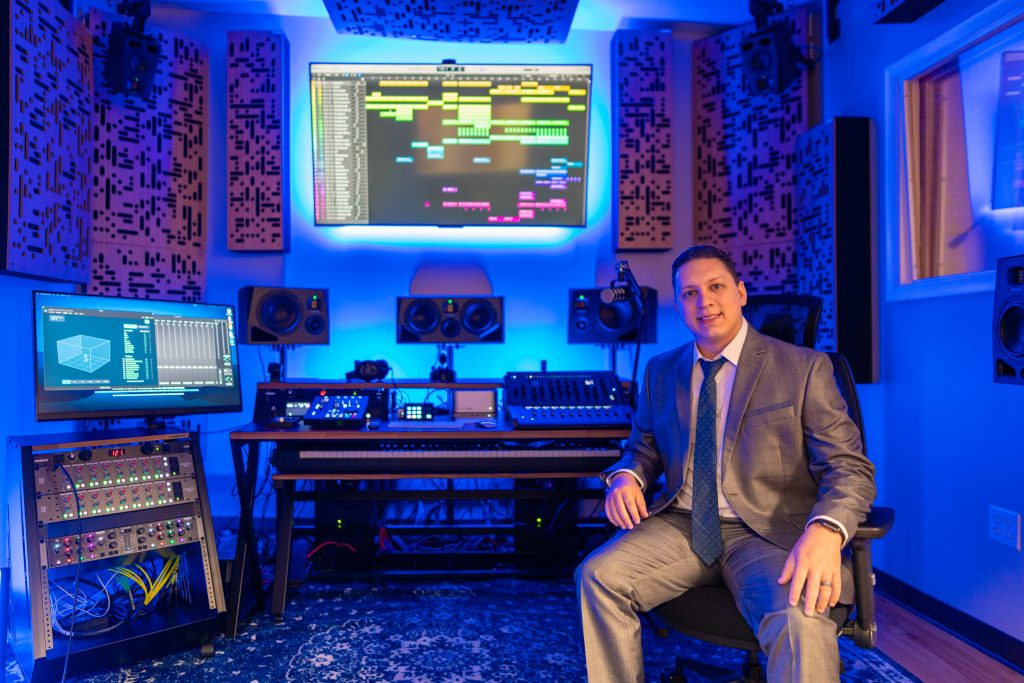
New Astral Recording Studio offers EMU students hands-on experience in cutting-edge music production, sound engineering, and audio technology
It might be the quietest spot on campus.
EMU’s new Astral Recording Studio, which opened this semester in the former Astral Hall building atop the EMU Hill at 1304 Hillcrest Drive, has been precisely engineered with one goal in mind: providing the ultimate environment for recording and mixing audio. From its comprehensive acoustic treatment to its full suite of top-tier audio equipment, every square inch of the space is designed to help producers capture the sounds they want while eliminating the ones they don’t.
For starters, take the physical structure of the building itself. The studio, featuring a 175-square-foot control room and two isolation rooms measuring 81 and 83 square feet, sits on its own concrete slab, separate from the rest of the building to minimize vibrations. Inside its walls, a 4-inch air gap makes the space practically soundproof from outside noise.
| Going the full measure Every detail of the Astral Recording Studio is designed to deliver the purest listening and recording experience. No two walls run parallel, with only one 90-degree corner per room, and even the ceiling and window panes are slanted to provide a clean, neutral sound. The studio also features a silent HVAC system, double layers of drywall, and all of the lights have been carefully checked to ensure they remain completely vibration-free, said EMU Music Professor Dr. Benjamin Guerrero, whose vision and expertise brought the studio to life. |
“If there’s noise or rattling, you end up spending too much time editing it out,” Guerrero said. “We’re aiming to replicate the professional studio environments of Los Angeles and New York City to better prepare our students for work in those settings.”
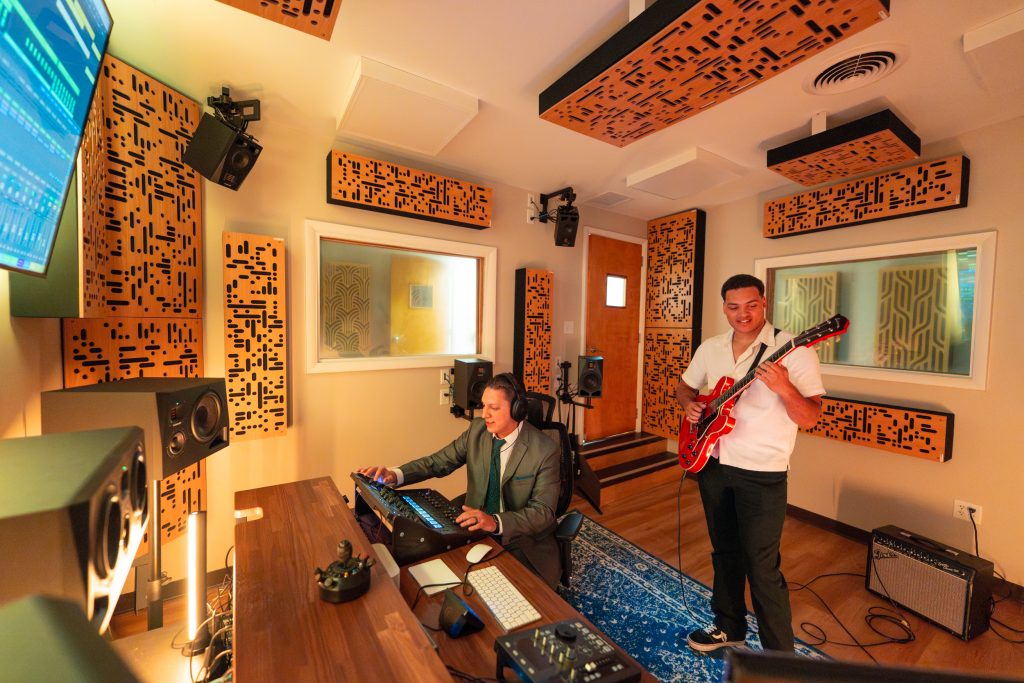
Take a look inside the studio and it quickly becomes clear just how much thought went into creating the optimal environment. Acoustic panels on the walls and ceiling absorb the high and mid frequencies, while bass traps in the corners absorb the low ones. Thirteen speakers are positioned around the control room, all directed toward the center of the room, where a control surface allows producers to mix dozens of channels with precision.
The control room is calibrated for Dolby Atmos 7.1.4, one of the highest standards in music production, which means that it has seven ear-level speakers, one subwoofer, four overhead speakers, and an additional subwoofer for bass management. Together, they create a three-dimensional sphere of sound that envelops the space. The studio can produce 3D audio, sometimes known as “spatial audio,” as well as binaural audio, delivering a more immersive listening experience than standard stereo.
“Not many studios near us have something like that,” Guerrero said. And almost none of them are open to members of the public, who can rent the EMU studio by the hour.
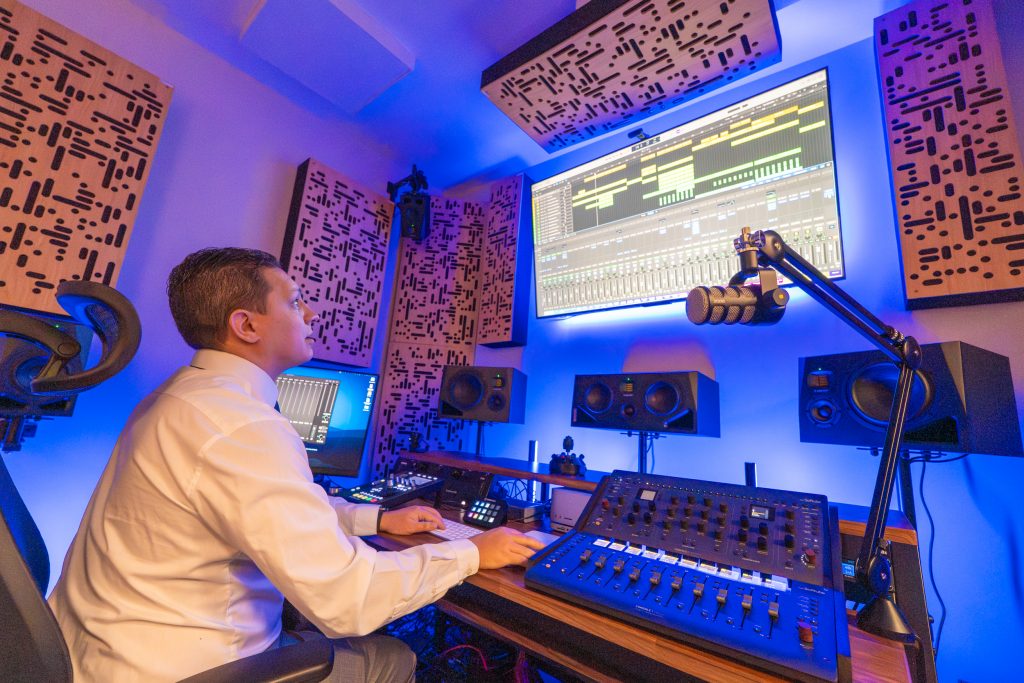
| High-tech specs The studio runs Apple’s Logic Pro, a widely used music recording software, on an M2 Ultra Mac Studio computer. A three-terabyte library of samples gives access to thousands of sounds and instruments, from guitars and keyboards played by The Beatles to Tolkien words sung in Elvish. “It would take me years to listen to all the sounds I have available here,” Guerrero said. |
Astral Recording Studio is open to EMU students, faculty, staff, and community members for recording and mixing music, videos, podcasts, or any other audio projects.
Learn more about the studio at astralrecordingstudio.com.

Guerrero said students in his Introduction to Music Technology and Video Game Music and Culture classes this semester will use the space as a hands-on lab to collaborate on projects. The studio has already hosted a few successful recording sessions for local musicians, and reactions to the space have been overwhelmingly positive.
When he’s not playing with his jazz group around town, Thaddeus Jackson ’24 can be found operating his own home recording studio. “It’s kind of amazing that a university this small has a studio like this,” he said, while he shredded on a guitar at a recent open house. The vocal performance and guitar grad helped Guerrero assemble much of the equipment in the EMU studio this summer, along with John Evans of Master Craft Construction and his apprentice, Kortney Bostic.
The studio could also serve as a space for audio research projects, Guerrero said. That might include comparing different microphones or other technologies, or using the controlled environment to study how we perceive and process sound.
When he was hired on as faculty a little more than two years ago, Guerrero had two objectives: build a recording studio and eventually develop a music technology major at EMU. He said a number of music students over the years had expressed interest in recording their own music and exploring audio production, often mentioning the need for a studio. He credited an initial $95,000 donation from a generous couple, who have said they wish to remain anonymous, with kickstarting the project, as well as consistent support from EMU administration and Music Program Director Dr. David Berry.
“The studio has been a dream in the making for many years now and it is wonderful to see it open its doors,” Berry said.
“It’s an amazing space with lots of capabilities,” he added. “I’m excited about all the possibilities it represents by giving access to more students, staff, and members of the community the ability to make music in new ways and explore their passions.”
Guerrero said music technology programs, like the one he envisions creating at EMU someday, have been shown to boost enrollment by appealing to students from nontraditional music backgrounds. “These are the students making beats at home or producing tracks, but who aren’t necessarily in marching band, orchestra, or choir,” he said. “If we can bring them in and help them see a future not just at EMU, but in a music career, I think the potential is huge.”
Now that the studio is finally open, Guerrero is excited to welcome people in. “Let’s collaborate,” he said. “Let’s work on something together.”
About the professor
Guerrero holds a PhD in music education from the Eastman School of Music (Rochester, N.Y.), a master’s in music technology from New York University, and a bachelor’s in drum set performance and contemporary writing and production from Berklee College of Music (Boston). While a college student, he worked at Apple stores in Boston and New York for three years, teaching workshops in GarageBand and Logic Pro. He previously taught at James Madison University and El Paso Community College in his hometown of El Paso, Texas.
He traces his interest in immersive audio back to the first time he watched Rush in Rio in 5.1 surround sound more than 20 years ago, and recalled attending an Audio Engineering Society conference at Dolby Labs in 2012, where he witnessed the first public performance of Dolby Atmos. “The sense of immersion was incredible,” he said.
About the space
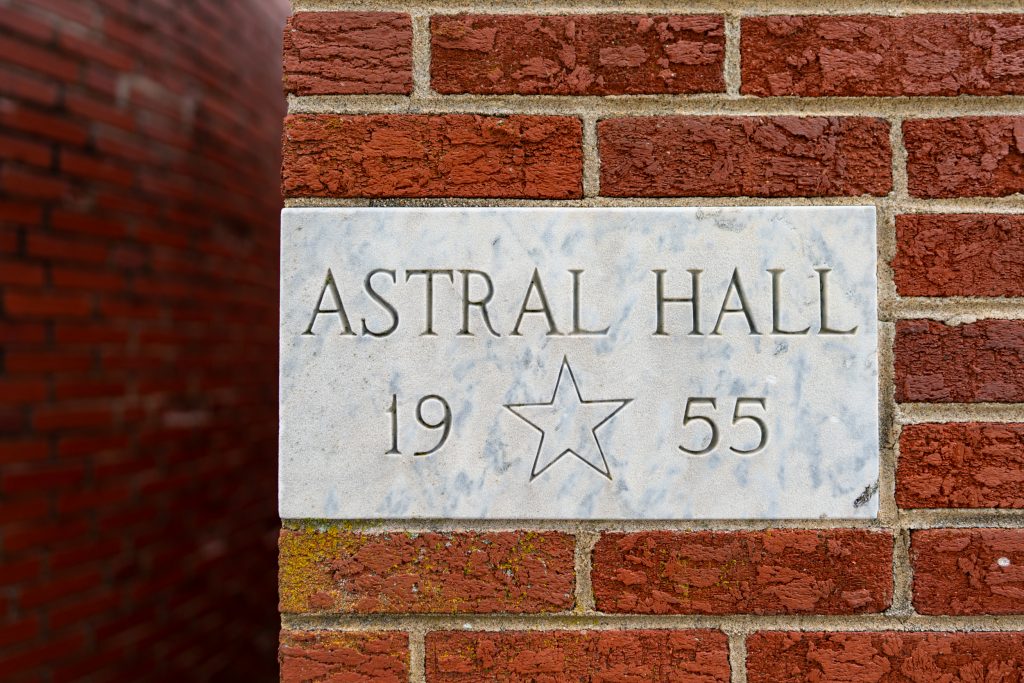
Built in 1955, the terraced, one-room Astral Hall building next to the Vesper Heights Observatory hosted astronomy lectures and Astral Society meetings. Read more about the early days of the building here.
In the early 1970s, the building was renovated into a recording studio for WEMC, the EMU student- and staff-run radio station that began broadcasting from Lehman Auditorium in 1954. Guerrero said the renovation set it up well for acoustic treatment, and some original features, including the windows and doors, remain in place today. “There were a lot of things that were done right in the design of this space,” he said.
As an EMU alum who cut his audio teeth working at WEMC, It is absolutely wonderful to see this space getting used for audio again! Love this!
This has been kicked around for 5 or more years; why can’t we have training in audio production in EMHS or EMU.
Having worked as a studio engineer for 22 years for Alive Studios (housed in what is now EMHS Elementary School) I am interested in seeing what you have to offer.