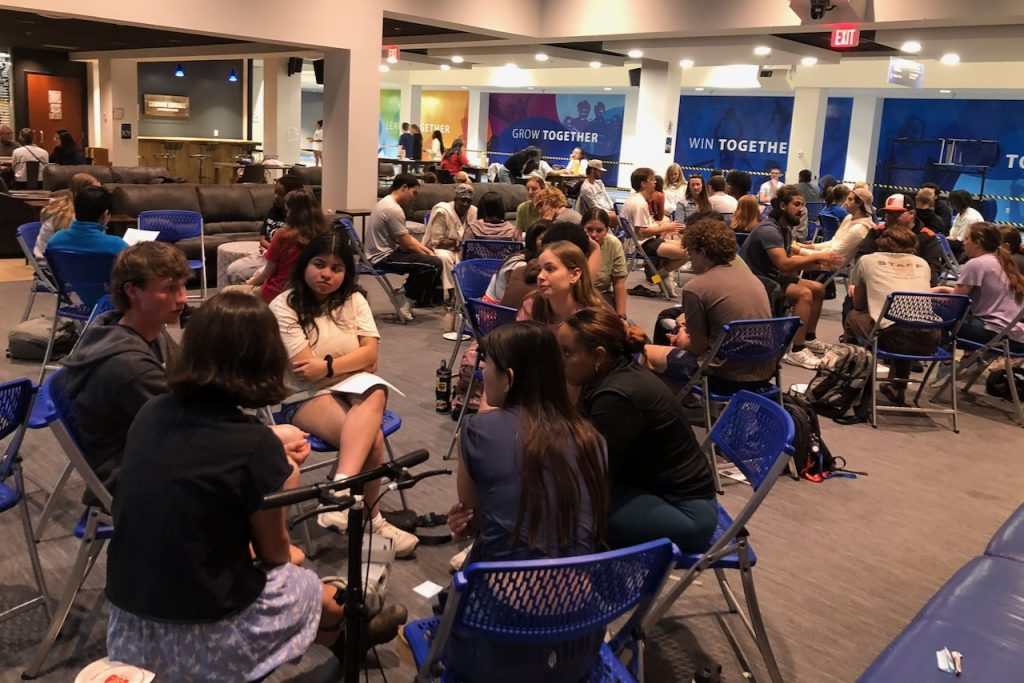
A “Disagree Together” discussion series, held across three consecutive Thursdays in March, provided a space for students of varying political identities to engage in conversation, ask the tough questions they often avoid, and connect across their differences.
Organized by the Student Government Association, College Conservatives, and Young Democrats, the series was funded by an Inclusive Excellence Grant from EMU’s Office of Diversity, Equity, and Inclusion, as well as a Pluralism Project Grant. About 50 students attended each session, held at the University Commons Student Union on the evenings of March 12, March 19, and March 26.
Senior biology major Maria Longenecker, who helped organize the series as SGA co-president, said she hopes it can serve as an example for others to follow. At a time of heightened political division, she said, it’s more important than ever to bring people together.
“EMU encourages us to work toward peace and justice and resolve conflict, and this feels so woven into our values,” she said. “I think we created something we saw was missing, and we see that missing in the world more broadly. It’s so tempting to disengage, but I hope this can serve as an example for how to lean in and continue to care for one another.”
‘The elephant on campus’
“Disagree Together” formed in response to tensions that student leaders felt on campus last fall. After a campus vigil for Charlie Kirk sparked arguments in the Royal Radar group chat, Longenecker said it became clear that students needed a space to discuss political issues.
“That demonstrated to us how much energy and conflict is under the surface here at EMU that we often don’t address,” she said. “It feels like the elephant on campus.”
SGA leaders heard from students across the political spectrum who said they felt ostracized and misunderstood because of their beliefs, with no clear place for them on campus. Longenecker and fellow co-president Leah Frankenfield believed it was important to pull in many perspectives to dream up a way forward. They met with the College Conservatives and Young Democrats to develop a space where students of all political persuasions could feel comfortable.
Dibora Mekonnen, co-president of Young Democrats, said the series created a meaningful space for students to engage in difficult and sometimes uncomfortable conversations in a respectful way. “I believe it has positively affected students by helping them become more open-minded and more willing to engage with perspectives different from their own,” she said. “In shaping the campus, the series has contributed to a culture of dialogue, understanding, and community-building by showing that disagreement does not have to lead to division, but can instead become an opportunity for learning and growth.”
Jacob Dwyer, president of College Conservatives, said he also felt the event was a success and was encouraged by the turnout. “I think it’s important that we engaged in meaningful dialogue,” he said. “Going into it, I knew we might not agree on everything, but because we were able to have open conversations, we gained a better understanding of why we each think about certain issues the way we do.”
Longenecker said she was surprised by how willing people were to be honest with one another. “I thought it would be harder to get people to have conversations about the things they disagreed on,” she said. “But once people got in a room, sat down, and started asking questions, it was beautiful to see that engagement happen.”
The Why and the How
The series unfolded over three sessions, each focusing on a different aspect of disagreement.
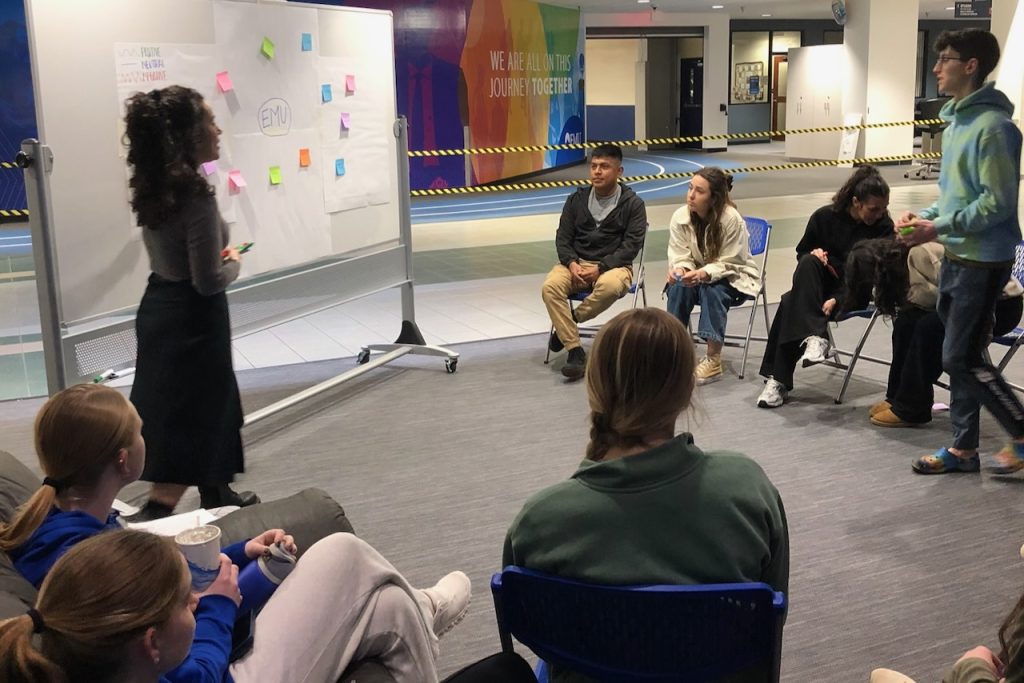
The first session centered on the question, “Why do we disagree?” Students mapped their identities to better understand how their experiences shape their beliefs and examined how those views are formed. Kory Schaeffer, director of programs for the Center for Justice and Peacebuilding, facilitated the discussion and offered guidance on creating a respectful environment for disagreement.
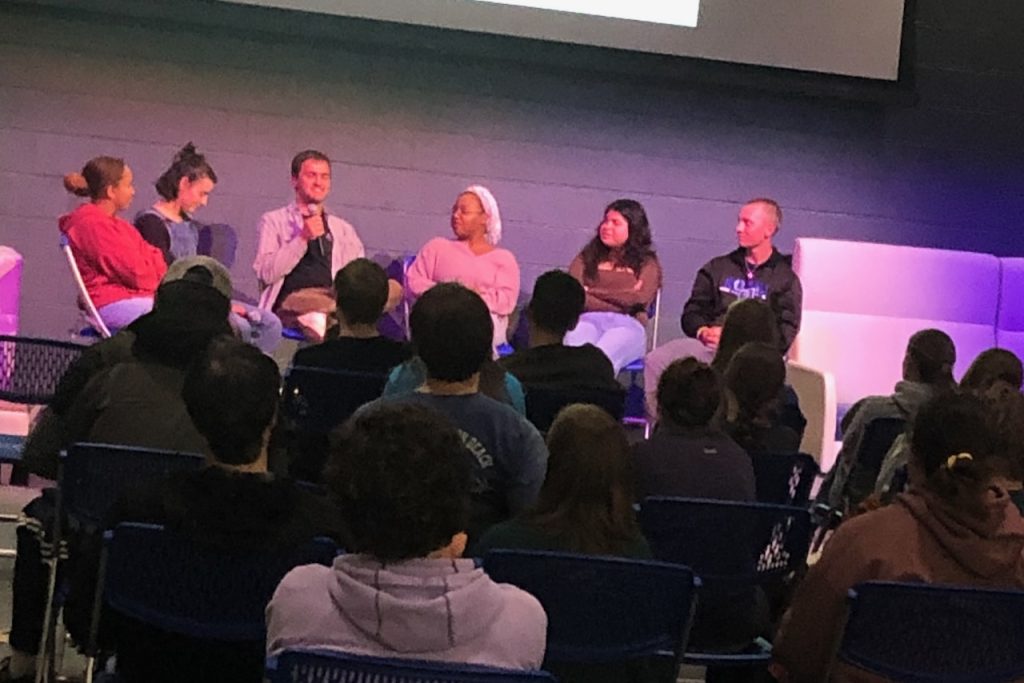
The second session was titled “How do we disagree?” and featured a panel discussion on politics and Christianity. “We thought that was important to discuss because EMU is an Anabaptist institution, and it’s such a central part of our values,” Longenecker said.
The third session, “Practice disagreeing,” invited students to sit in small groups and ask one another questions about political topics or anything else they were curious to explore. “It was beautiful to look around and see people, who I’ve never seen talk to each other before, sit down and have these deep conversations about their beliefs,” Longenecker said.
She said she believes new relationships have formed as a result of the “Disagree Together” series, especially during the third session. “I hope people walked away feeling like someone new sees them as a person first and is also interested in hearing their beliefs,” she said. “I hope it’s started conversations that will continue.”
As members of the SGA executive board prepare to hand off leadership to their successors, she said they’ve developed a plan outlining how future boards can respond and create similar spaces for students to engage in difficult conversations if another contentious event arises on campus. “I see this as a beginning, not the end,” she said.
I would love to see more in depth story telling on what people shared with each other and what they learned. Having safe space created for discussion is so valuable… and so many churches just “don’t talk about politics” to avoid the conflict.
Thank you so much, Maria and EMU students!!
The SGA political club at EMU is a step forward in the right direction.It is the right way engage students in political discourse ,activism, eliminate borders , share resources and explore the feasibility of a unified global state.
Prof Dr.Samir Abuznaid
EMU.
Class,1980
Eastern Mennonite University is the first institution of higher learning I have been to in 1977.Coming from Hebron ,Palestine as a young high school graduate EMU has fostered my attributes as a graduate .EMU did develop my critical thinking,confidence,leadership skills and adaptability.EMU put me on the right track.It is the first university to put me on.Overall, EMU helped me grow personally and professionally.
Love,
Professor Dr.Samir A. Abuznaid , EMU class 1980
Hebron University
Director
International Relations Unit
sameerz@hebron.edu