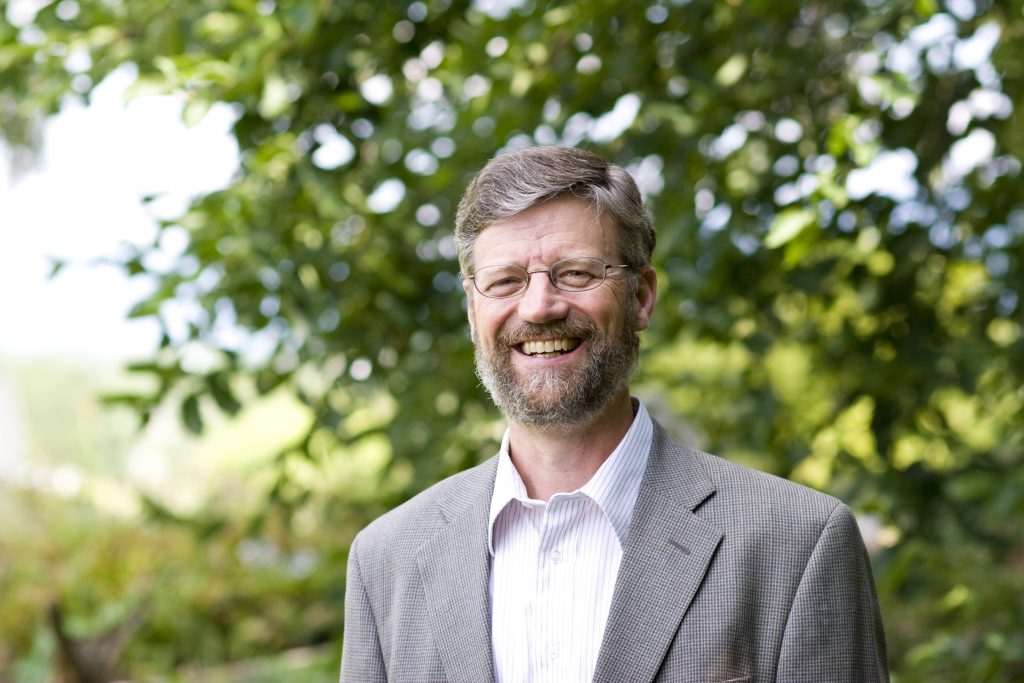
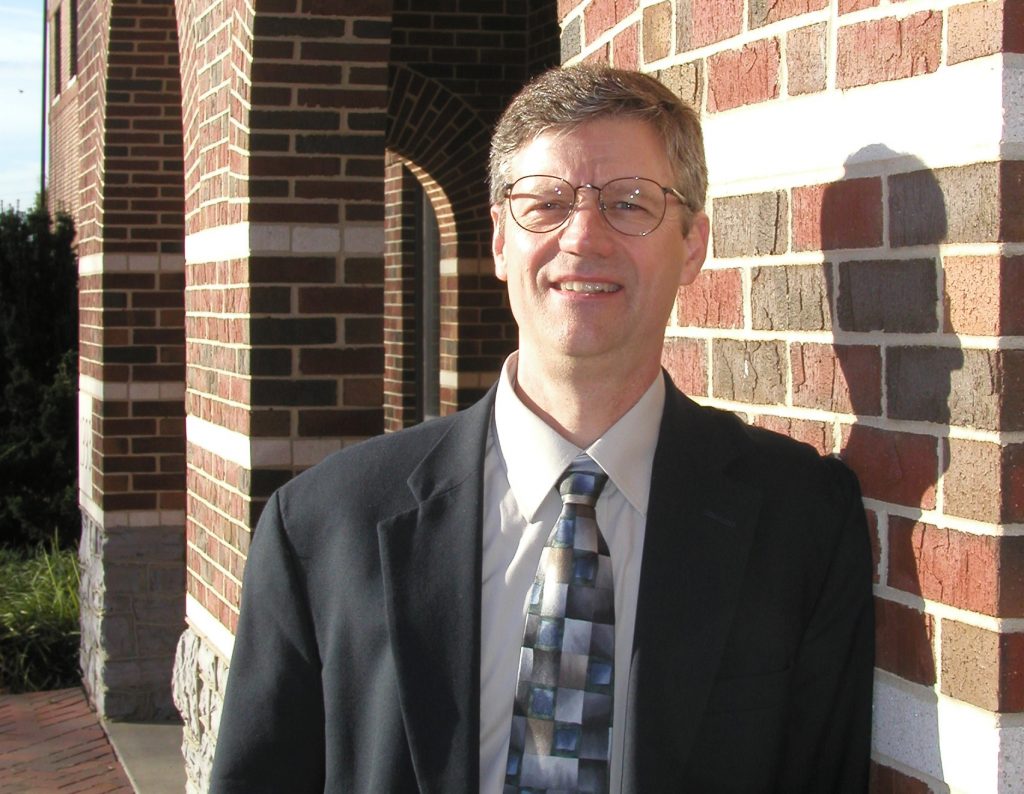
A man of God blessed with many talents, Dr. Ervin Ray Stutzman MA ’99 (religion) used those talents to enrich the lives of those in the communities he served and the church he dearly loved.
Stutzman taught at Eastern Mennonite Seminary (EMS) as associate professor of church ministries starting in 1998, and served as academic dean of the seminary from July 2000 to December 2009. He then led Mennonite Church USA (MC USA) as executive director from 2010 until his retirement in 2018.
He was known by many as a master woodworker, skilled handyman, prolific author, disciplined goal-setter and writer of life-purpose statements, problem solver and mentor, teacher and preacher, and loving husband, father, and grandfather. He is also remembered for his seemingly limitless reserve of energy, his deep commitment to Christ and the church, and the close relationships he formed with those he worked with and served.
Stutzman died on June 3, 2025, at age 72 from complications following a five-year battle with cancer. A memorial service was held on June 8 at Park View Mennonite Church in Harrisonburg, where he was an active member. View a recording of the service, along with the full obituary, on the church’s website here: pvmchurch.org/ervinstutzman.html
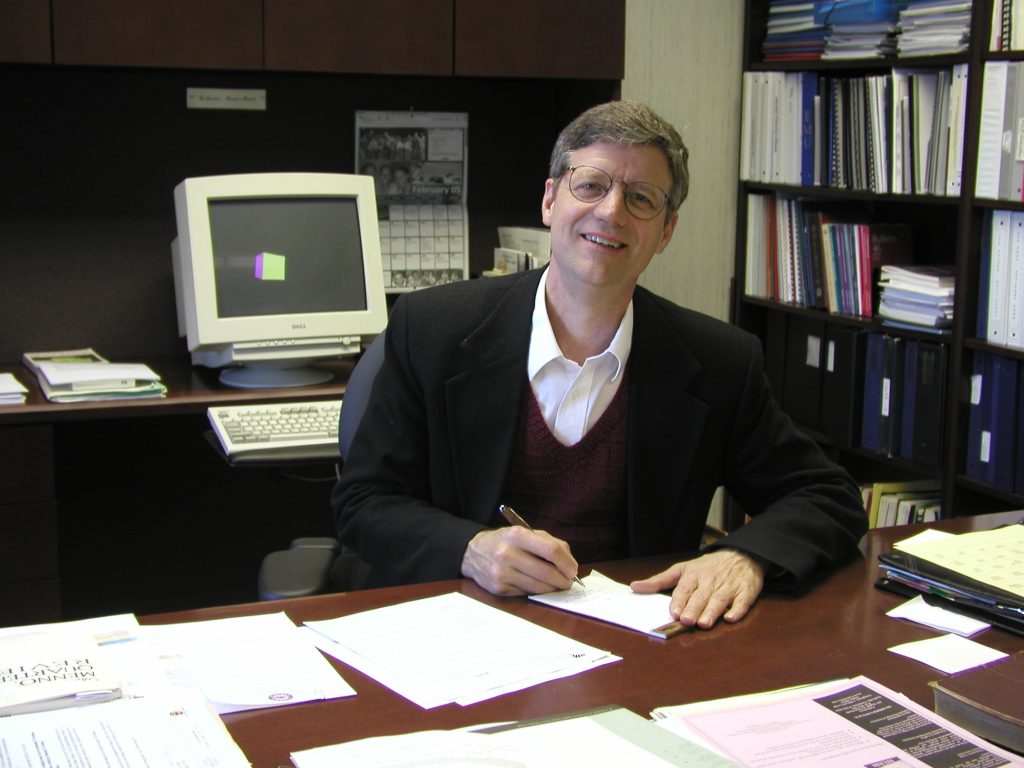
“Ervin was deeply committed to the church and to preparing seminary students to serve and lead in pastoral and other roles,” said Dr. Loren Swartzendruber, president of EMU from 2003 to 2016. “He was a gifted administrator who contributed wisdom and energy to the entire university while serving as dean of the seminary. He was also a much-loved professor and mentor to many students.”
Professor Emeritus Lonnie Yoder, who was on the seminary faculty from 1991 to 2021, described Stutzman as a caring administrator and “very supportive dean.” “He was incredibly committed to his role and to the relationships he had with faculty and students,” Yoder said. “He was very purpose-driven. He believed we should all develop life-purpose statements and encouraged all of us to work on them.”
Stutzman himself had written a life-purpose statement that he often referenced, Yoder said. According to an article by MC USA, part of Stutzman’s statement read: “In response to God’s love expressed in Jesus Christ, by the power of the Holy Spirit, I purpose to follow after God with all my heart … so that God may be glorified in my life at all times and in every way.”
“He was one of the most highly disciplined people I think I’ve ever met,” Yoder said. “I was always amazed at his capacity to do everything that he did.”
Among Stutzman’s contributions to EMS was a $2 million grant from Lilly Endowment Inc. to develop the LEAP (Learning, Experiencing, And Participating) Program. The initiative, which began in 2003, aimed to help high school students hone their leadership skills, explore Christ-centered theological studies and pastoral ministry, and engage in intercultural learning experiences (with travels to countries including Zimbabwe, Jamaica, and Colombia).
“The key was that Ervin, and it was a stroke of genius by him, wanted the program to be characterized by diversity,” Yoder said. “It allowed high school-age youth to get outside their comfort zone and engage with other talented and committed youth. In that sense, I think Ervin was ahead of his time.”
Stutzman was born on April 27, 1953, in an Amish home in Kalona, Iowa, to Emma and Tobias Stutzman. He grew up in Hutchinson, Kansas, where his family moved after his father’s death when Stutzman and his twin, Erma, were just three years old. He was the only one in his family to graduate from high school.
Stutzman received his PhD in rhetoric and communication from Temple University (1993), MA degrees in religion from EMS (1999) and communications from the University of Cincinnati (1979), and a BA in Christian ministries from Cincinnati Bible College (1978).
He wrote several historical novelizations of true Amish stories, including those of his parents’ lives, Emma: A Widow Among the Amish and Tobias of the Amish, and Return to Northkill, a three-book series on the life of his ancestor, Jacob Hochstedler. He also wrote several other books about Mennonite history, life, and thought.
Professor Emeritus Dorothy Jean Weaver, who joined the seminary faculty in 1984 and retired in 2018, noted Stutzman’s productive nature. “The fact that, in the midst of everything else he was doing, he wrote all those books, shows some real commitment and focus,” she said.
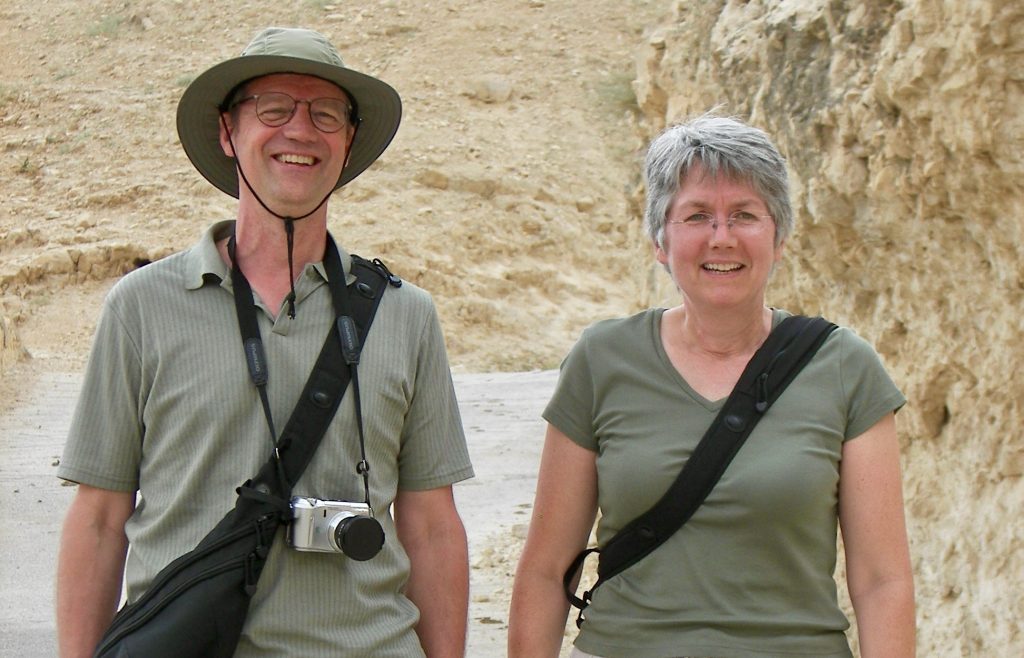
Weaver co-led a 2007 study tour to the Holy Land that Stutzman and his wife, Bonnie, joined and recalled that the couple were part of a small group that climbed the steep slopes of Mount Tabor on foot. “I was always a little worried that Ervin would assume the rest of us had the same level of energy he had,” she said.
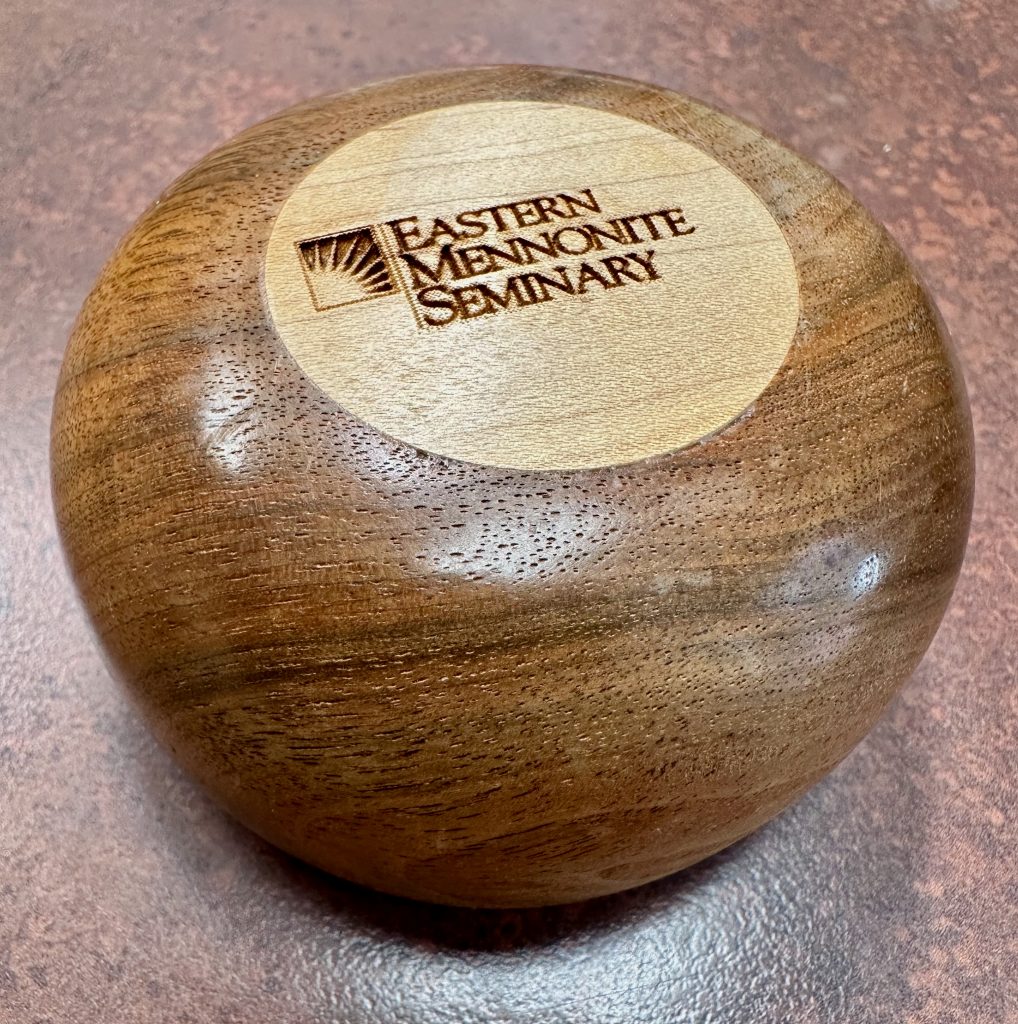
Another vivid memory Weaver has of the former EMS dean is of the beautifully handmade wooden crafts that Ervin and Bonnie gifted seminary faculty and staff each Christmas. One of those gifts, a domed wooden paperweight inscribed with the EMS motif and initialed “ERS ’06,” remains on some office desks in the Seminary Building today nearly 19 years after being given.
“I think of him being well-placed in this seminary because he was naturally gifted as a strong administrator and he cared ever so deeply about the church,” Weaver said. “He was the right person at the right place.”
At EMS, Stutzman succeeded George Brunk III ’61, SEM ’64 as dean. He was followed by Dr. Michael King ’76, who became dean in July 2010 after a six-month interim term by Sara Wenger Shenk. Before becoming dean, King, as owner of Cascadia Publishing House, had worked with Stutzman to prepare his book, Tobias of the Amish, for publication. “In that sense, I had a lot of opportunity to get to know him,” King said.
“He was a very hard worker,” King said. “He was passionate about fulfilling his assignments as a leader.”
One of the most challenging roles of the dean’s job is to maintain accreditation with the Association of Theological Schools (EMS has been an accredited member since 1986), as well as the support of the United Methodist Church for training its Methodist students. Both of those accreditations were key to maintaining a student body in numbers high enough for EMS to remain successful and viable.
“During my tenure, I worked closely on both accreditations, always building on the work Ervin had done,” said King, dean of EMS from 2010 to 2017. “I always knew I owed a tremendous debt to the very careful work Ervin had done in setting the stage in prior accreditations.”
While dean, King was an advisory council member of the seminary’s Preaching Institute, a program Stutzman established and chaired that provides pastors and lay leaders with an opportunity to develop their preaching skills. “That was an excellent experience,” King said. “I believe it may be on hiatus at this point, but it was a very valuable program in its day.”
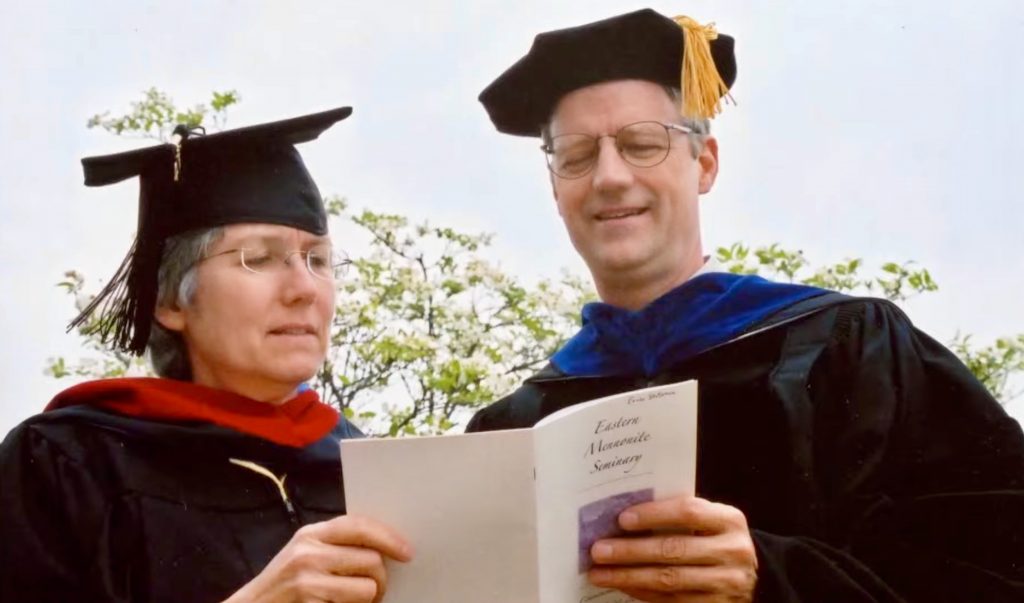
Ervin married Bonita “Bonnie” Lee Haldeman MA ’05 (church leadership) of Manheim, Pennsylvania, in 1974. Together, they served as volunteers for Rosedale Mennonite Missions in Cincinnati for five years.
In 1982, at age 29, Ervin moved with his young family to Lancaster, Pennsylvania, and became associate pastor of Mount Joy Mennonite Church, while also serving as the associate director for Home Ministries at Eastern Mennonite Missions. Just 18 months later, he began a half-time role as district overseer for Lancaster Mennonite Conference, and from 1991 to 2000, he served as their conference moderator.
“As I recall, he once joked that he lived his adult life in decades,” Yoder said. “He was involved in Lancaster Mennonite Conference for a decade, and then EMS for a decade, and then MC USA for a decade, approximately.”
Bonnie, who supported Ervin as his wife for 51 years, described him as “everyone’s dream of a husband—he would do whatever needed to get done.” At their home just a handful of blocks from campus, Ervin built all the cabinets, countertops, bookshelves, and furniture. She said he spent six months creating a 290-page, leather-bound book of journal entries, photos, and reflections as a gift for their 50th anniversary. “He was always teaching himself new skills,” she said.
“He was a visionary,” she said, “a big-picture person.”
In their retirement, Ervin and Bonnie biked thousands of miles on their e-bikes and traveled the country in their RV. Before he died, he wrote a yet-unpublished memoir.
“He was nourished by being outdoors, eating good food, regular church attendance, a spiritual life of prayer and contemplation, and keeping peace with fellow people,” Bonnie said. “He was a man of integrity.”
Ervin was preceded in death by his son Daniel Tobias Stutzman. His beloved spouse Bonita survives, as do two children: Emma Ruth (Stutzman) Dawson (Iowa City, Iowa), along with her sons Felix Tobias Dawson and Caius Lysander Dawson, and Benjamin Lee Stutzman and his wife Andrea Joy (Kniss) Stutzman (Harrisonburg, VA), along with their children Eva René Stutzman and Evan Rafael Stutzman. His twin Erma Mae (Stutzman) Yoder (Ephrata, PA) is his only surviving sibling.
Portions of this article are from the obituary on Ervin Stutzman.
I have fond memories of my interactions with Ervin, during my time on the EMU campus as a CJP student (2004-2005). I was introduced to Ervin by the late Dr. Anil Solanki, EMU seminary professor. I remember Ervin as an energetic, gracious, kind, person with a healthy curiosity and an open mind. He invited me over to his home a couple of times to share meals and conversations on several topics with his family. Yes, certainly, a big picture, visionary!
My deepest sympathy and warm embrace to Bonny and other family members.
Merwyn De Mello