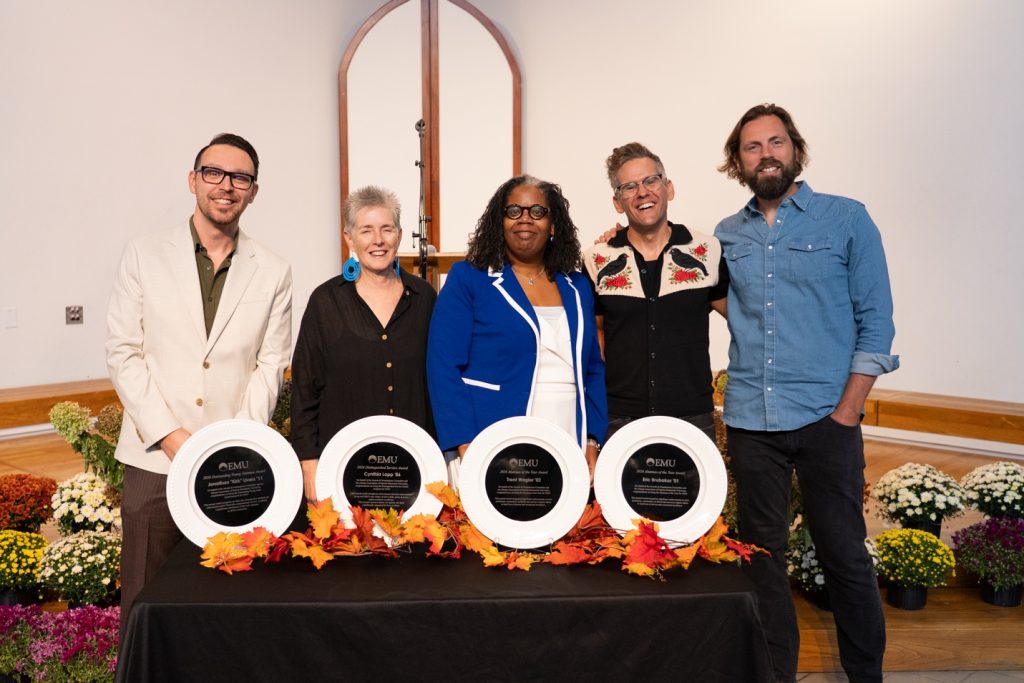
EMU hosted its annual TenTalks event Saturday afternoon, featuring Alumni of the Year Eric Brubaker ’01 and Trent Wagler ’02 of The Steel Wheels, Distinguished Service Award recipient Cynthia Lapp ’86, and Outstanding Young Alum Award recipient Kirk Livers ’11. Each had 10 minutes to impact, influence, and inspire the crowd.
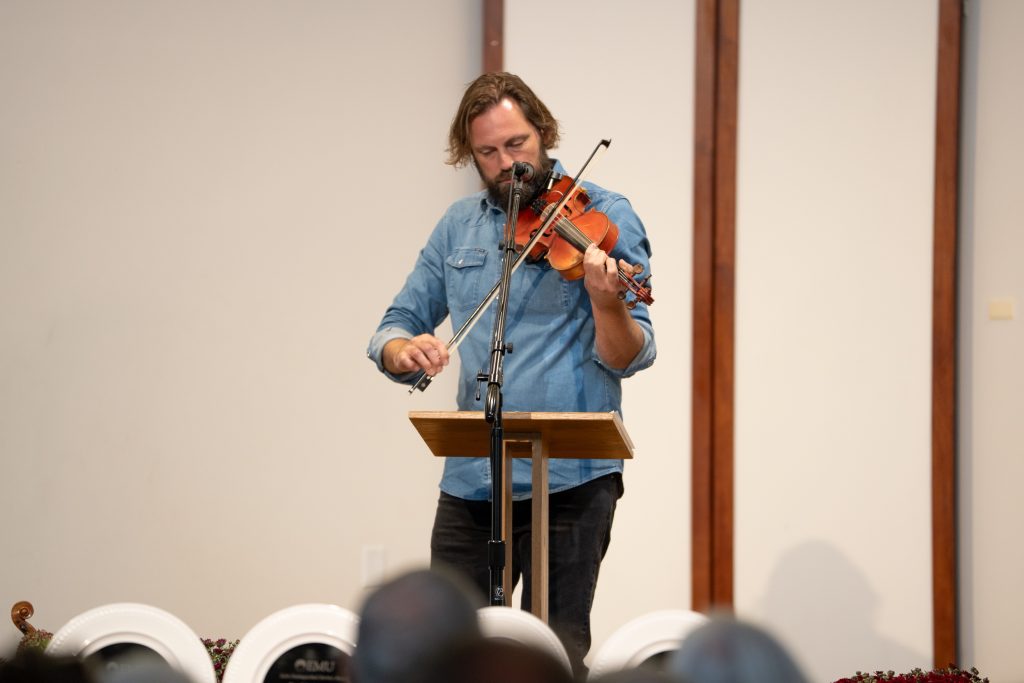
Eric Brubaker ’01
Brubaker is a founding member of The Steel Wheels, which has performed at venues and festivals across the country for over two decades. Through the band, he hosts the Red Wing Roots Music Festival and Red Wing Academy, a four-day strings camp for youth. In 2024, he and his wife, Peggy ’00, formed a nonprofit to provide scholarships to academy students.
A tune is an ephemeral thing that lasts only as long as it’s being played, and it’s never played exactly the same way twice, Brubaker said.
“How can something so malleable and fragile last so long?” he asked.
Brubaker described how, as recording technology became more portable, folklorists traveled to rural communities to document the music of banjo and fiddle players, hoping to preserve a uniquely American musical tradition.
“They treated the tunes and even the practitioners as artifacts, something to be kept, untouched, and collected,” he said. “But this music was never fixed. It was always an evolving ferment of sounds and cultures.”
Brubaker recalled learning violin through the Shenandoah Valley Preparatory Music program and playing his first fiddle tunes on the EMU campus. After years of performing across the country with The Steel Wheels and other roots musicians, he said he has come to understand traditional music as a living, evolving language.
“It’s a tradition of gathering, remembering, dancing, and sharing,” he said. “It’s a tradition worth preserving but you can’t preserve it by keeping it still.”
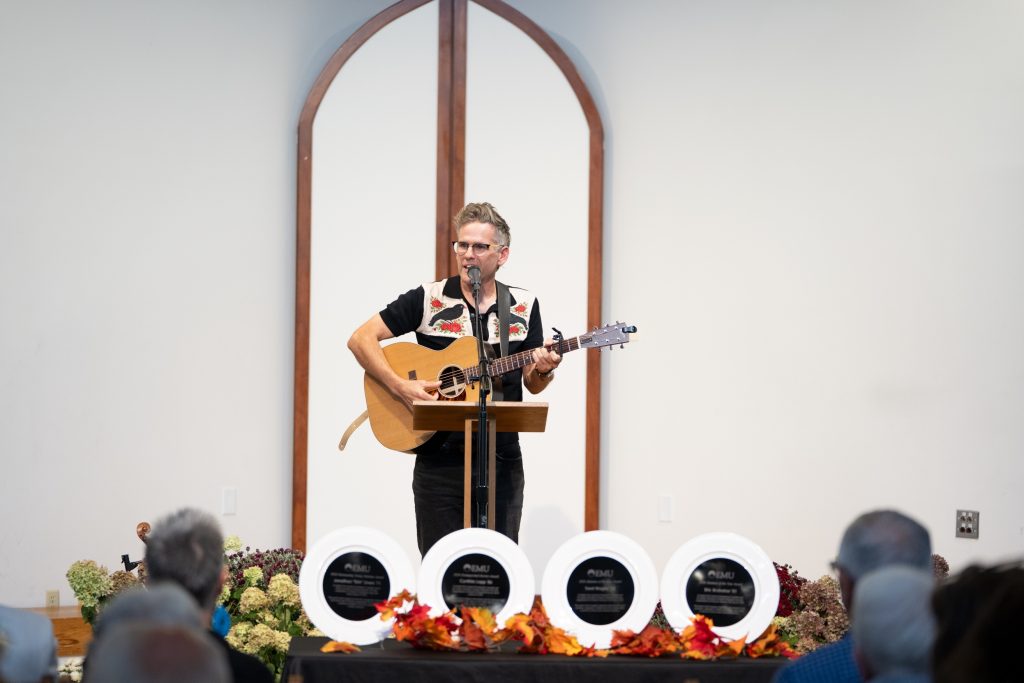
Trent Wagler ’02
Wagler is a founding member of The Steel Wheels, which has toured internationally and will perform at the Grand Ole Opry on Sunday. In 2025, he co-founded Rocktown House of Music, a community music school in Harrisonburg. He previously taught songwriting at EMU and holds degrees in theater and peace, justice, and conflict studies.
During the COVID-19 pandemic, when music venues across the country shut down, The Steel Wheels began writing and recording personalized songs for fans and friends through a project called “Everyone a Song.” Over two years, the band produced more than 120 original songs.
“We kind of became this little song factory within the band where one day we’d be writing a song for somebody’s anniversary, the next day it would be for somebody’s birthday or maybe for a memorial,” Wagler said.
With recent advances in artificial intelligence, anyone can now generate a song without contacting a musician, he said. But producing a finished song was never the point of the project.
“The goal of our project was never to deliver the perfect song,” he said. “It was to connect with someone’s story, to sit with that, to process it into a song in our own little Steel Wheels way, and it’s that process I think these tools could be really stealing from us.”
Wagler compared the creative process to taking a memorable vacation and hanging a photograph from the trip on the wall.
“You have that picture, but you don’t just want the picture,” he said. “You want to have gone on the trip. You want to have had the adventure.”
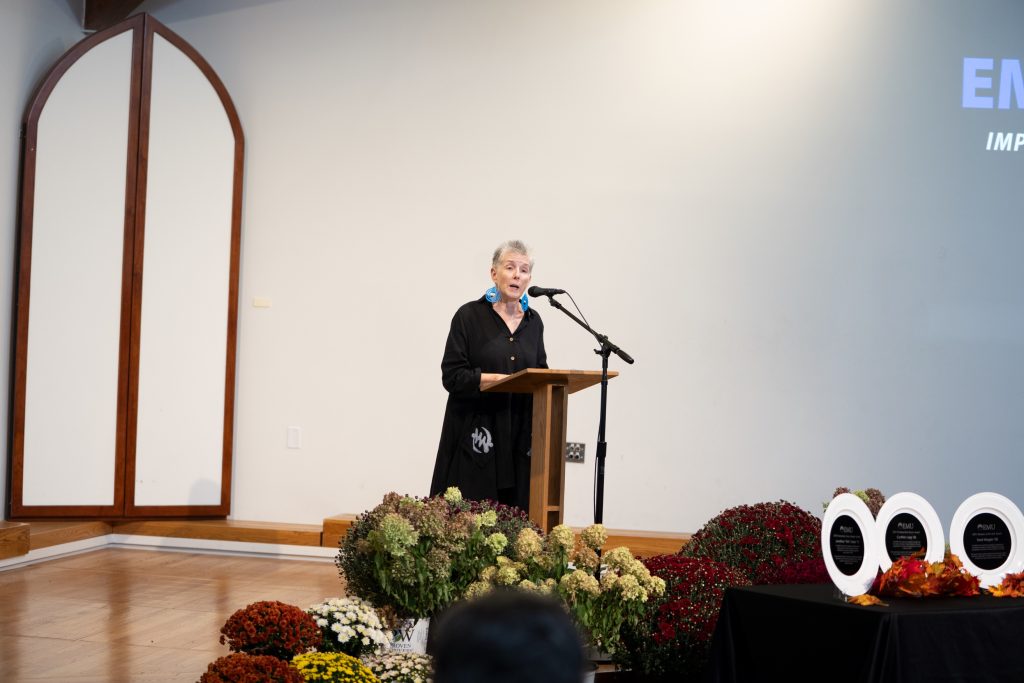
Cynthia Lapp ’86
A music education graduate, Lapp taught music, performed in the Washington D.C. area, and helped direct the EMU Washington Semester program. She also worked with the Women’s Alliance for Theology, Ethics, and Ritual (WATER) and graduated from Wesley Theological Seminary in 2003. She has served as pastor of Hyattsville Mennonite Church in Maryland since 2003.
Lapp spoke about the importance of showing up for others, particularly those whose voices and experiences are too often overlooked.
Whether supporting LGBTQ+ members of her congregation, caring for her children, standing alongside vulnerable and marginalized communities in the Washington D.C. area, advocating for Palestinians, or supporting immigrant neighbors, she said, “showing up is a matter of wholeness for all of us.”
Lapp reflected on the Mennonite tradition of supporting others within the congregation and the importance of extending that same commitment beyond church walls.
“We’re beginning to understand that our own peace and liberation is woven together with our neighbors near and far,” she said.
Showing up, she emphasized, doesn’t require having all the answers or taking the lead.
“It doesn’t even mean we have to be in the streets,” she said. “Showing up means we are committed to our collective liberation. Our shared futures depend on each of us showing up.”
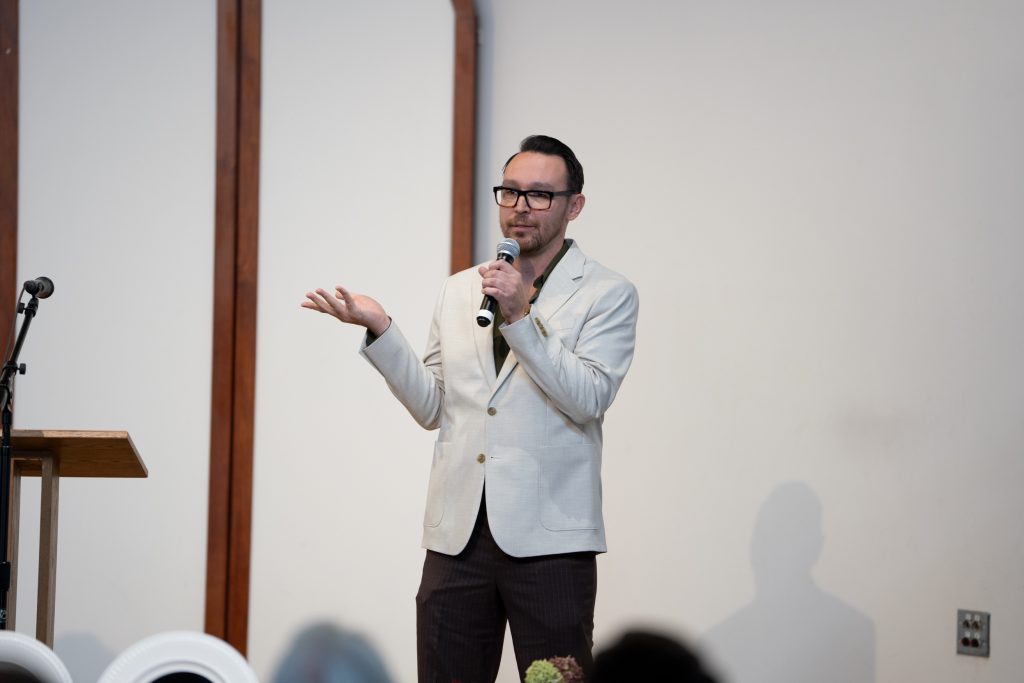
Kirk Livers ’11
After graduating with a degree in biochemistry and a minor in music, Livers worked for the Humane Society of Washington County (Maryland) before earning a master’s degree in physician assistant studies from Shenandoah University in 2018. A nationally certified physician assistant, he has served patients in his hometown of Hagerstown, Maryland, since 2020, providing care in a medically underserved community.
Livers recalled arriving at EMU in 2007 with his “whole life planned out.” After graduating with a biochemistry degree in 2011, he intended to attend medical school and become a physician.
“However, as we all know, life happens,” he said. “And quickly, my neat and detailed plan was derailed by the great equalizer, disease.”
Around the time of his graduation, his mother began experiencing shoulder pain that initially seemed like a cold settling into her body. The pain spread and eventually interfered with everyday activities. She was diagnosed with lupus and began trying different medications to manage her symptoms.
During one medical appointment, Livers recalled, a provider stopped taking notes, took his mother’s hands, and expressed sympathy for what she was experiencing.
“It was a really simple gesture, but it was the first time that someone beyond her family had shown her compassion and empathy for what she was feeling,” Livers said. “She didn’t dismiss my mom or label her as drug-seeking. She simply listened.”
That moment helped shape the kind of medical professional he wanted to become.
“I knew that day that if I ever was able to make it as a medical provider, I wanted my patients to feel the exact way my mom and I felt at that appointment.”
Livers said his experiences at EMU strengthened his empathy and helped him recognize the importance of connecting with patients as people first.
“There is far more that connect us as humans than divides us, and my patients show me that every day,” he said. “Remember that we are all connected, regardless of our circumstances. To me, practicing medicine is remembering that we are all a part of this community and we must remember to care for one another, just as EMU cared for me.”
Watch a recording of the event below!
Join the Discussion on “Alumni impact, influence, and inspire at TenTalks”