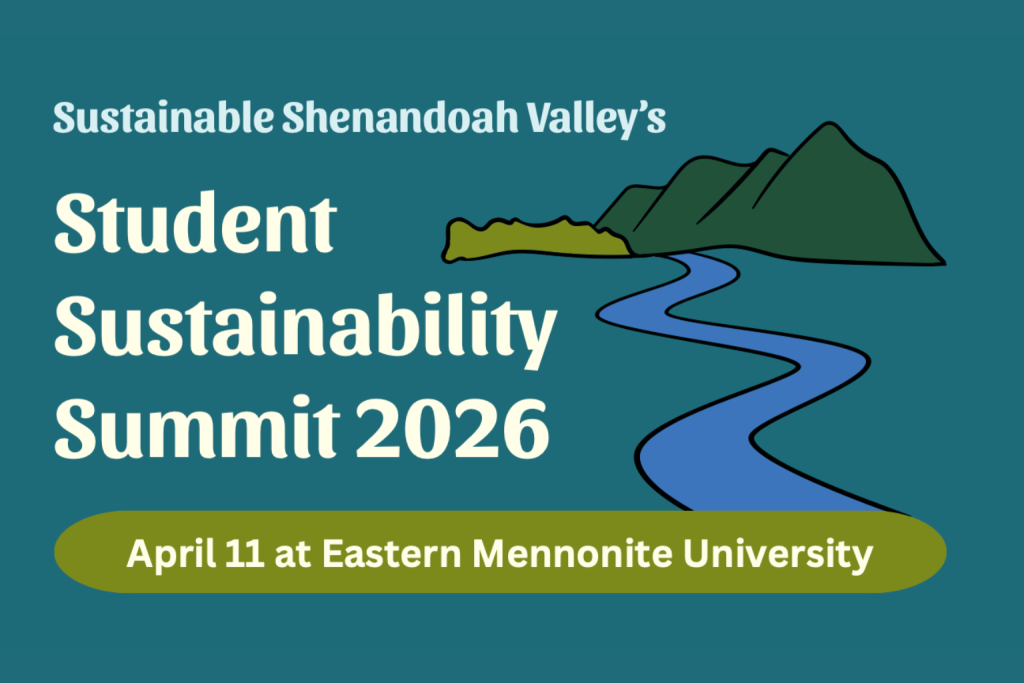
EMU will host the fifth annual Student Sustainability Summit in partnership with Sustainable Shenandoah Valley on Saturday, April 11.
The summit will be held at EMU’s Suter Science Center (1194 Park Road, Harrisonburg, Virginia) with events starting at 9 a.m. It aims to bring together students, educators, and community members to explore undergraduate research, innovative initiatives, and real-world solutions.
Students will attend from Sustainable Shenandoah Valley’s five member institutions: Blue Ridge Community College, Bridgewater College, EMU, James Madison University, and Mary Baldwin University.
“By celebrating the impactful work already happening across the region, this event seeks to inspire new ideas, partnerships, and pathways toward a more just and sustainable future,” the summit’s website says.
A schedule on the website lists presentations by local students and officials, posters and networking opportunities, and a keynote speech by John C. Jones.
Jones is an assistant professor in the School of Life Sciences and Sustainability at Virginia Commonwealth University. His main research interests surround the intersection of urban food system development, urban food insecurity, local governance, and the challenges facing America’s cities. In recent years, he has begun to research interventions to mitigate college student food insecurity.
EMU students Ciela Acosta, Kate Stutzman, Jenna Oostland, and Tara Cahill are among those who will deliver presentations at the summit.
Acosta will present on examples of campus organizing and advocacy that have taken place on EMU’s campus, including bell ringing for Palestine and direct action for sustainability, according to the summit’s website. Her presentation will include an empowerment discussion for students to be able to notice where inequity is present on their own campuses and be able to effectively and peacefully call for change.
Stutzman, Oostland, and Cahill will lead a comprehensive analysis of EMU’s carbon emissions for the 2024-25 academic year in accordance to the university’s climate goals. Emissions from a number of sources are considered including, but not limited to, food production and waste, purchased electricity, natural gas, fertilizer and pesticide use, student and faculty travel, and EMU’s solar grid.
Register for the summit here.
For more information, visit the event’s website here.
Join the Discussion on “Student Sustainability Summit seeks to inspire new ideas, partnerships, and pathways”