One EMU grad is creating quite the buzz.
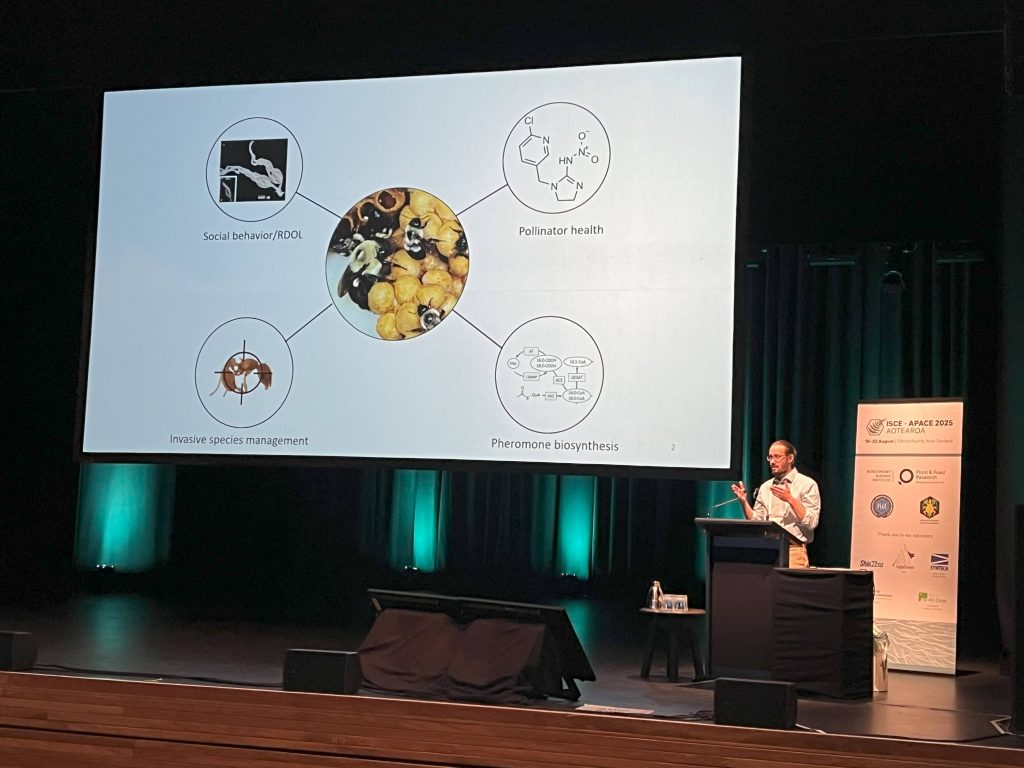
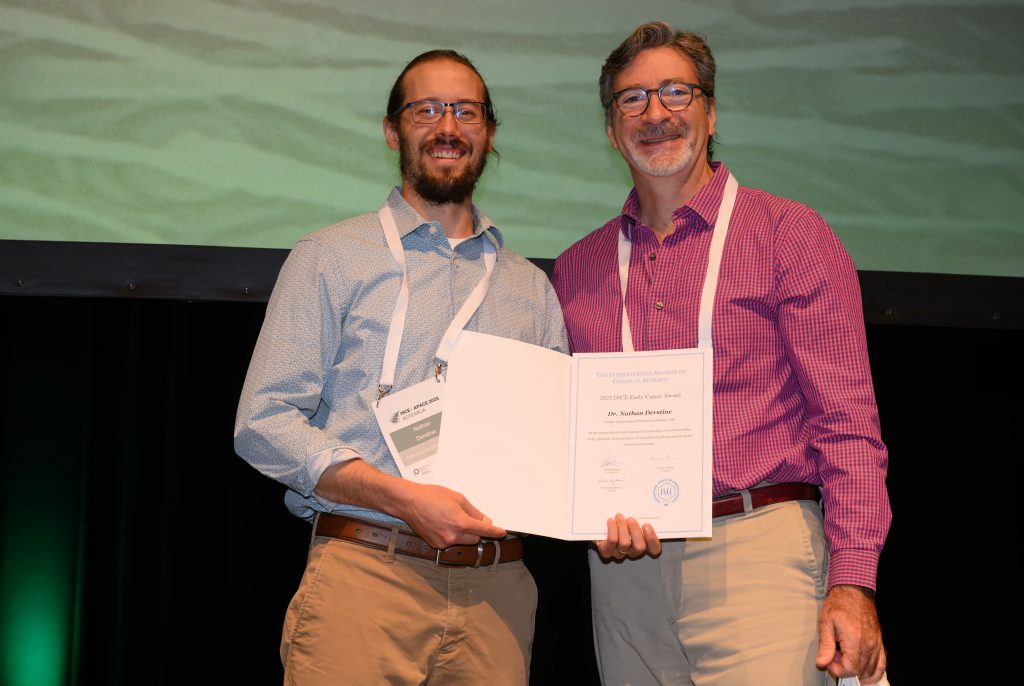
Nathan Derstine ’10, a chemical ecologist and physiologist whose research focuses on insect pheromones, was recently recognized for his groundbreaking work on how bees, wasps, and other insects communicate. He received the Early Career Award from the International Society of Chemical Ecology (ISCE) at its annual meeting held in New Zealand this past August.
The award recognizes “cutting-edge research in any area of chemical ecology performed by the new generation of scientists” and is open to researchers within 10 years of earning their PhD, according to the ISCE website. It honors Derstine for “his outstanding achievements in advancing our understanding of the plasticity and regulation of chemical signals governing social behavior in insects.”
What is chemical ecology?
Chemical ecology is the study integrating chemistry and biology to examine the chemical interactions among organisms and their environment. It includes signaling processes and communication between individuals, for instance in pheromone responses. (Nature.com)
“There are so many remarkable and excellent researchers who are equally, if not more, deserving of this award, so I didn’t expect to get it,” Derstine said. “I’ve had the opportunity to work on a wide array of projects with a lot of great mentors, and it feels very affirming to be recognized for all the work I’ve done and put in over the years.”
Along with receiving the award, Derstine was invited to present a plenary lecture on his research at the conference, with all travel, accommodation, and conference fees fully covered. “It was a great trip,” he said. “It was cool to see New Zealand and connect with a different group of chemical ecologists. It’s always rewarding to put a face to the names of the papers you’ve read.”
He arrived back in the U.S. two days before fall classes started at the University of Richmond, where he teaches as a visiting assistant professor of biology. Since moving to the city this summer, he’s been approached by more than one solicitor who’s knocked on his door and offered to spray for bugs. “I always have to tell them that they’re barking up the wrong tree,” he said.
Planting the seeds
Derstine said he’s always been interested in biology, but had never thought of himself as an entomologist or “insect person.” “In retrospect, I realize I may have had a unique background compared to others,” he said.
His parents were beekeepers for as long as he’s been alive—his father Kenton, professor emeritus at Eastern Mennonite Seminary, maintained a few bee hives on the EMU Hill back in the day—“so I grew up doing it and never thought of it as anything other than normal,” he said.
While at EMU, most of his student research was with Roman Miller, professor emeritus of biology, on how plant hormones affect the development of reproductive organs in mice. He got involved in Professor Matthew Siderhurst’s entomology research and spent two summers as a student at a U.S. Department of Agriculture lab in Hilo, Hawaii, where he worked to identify and develop strategies for managing invasive pests such as the little fire ant.
“That was the seed of where it all began, through my involvement with Matt,” said Derstine, who remains in close communication with the professor.
He said that EMU’s small class sizes, as well as the biology program’s exclusive focus on undergraduate students, helped him form close connections with faculty and allowed him to gain hands-on experience working alongside professors as they conducted research projects. “That’s a big benefit,” he said. “There’s no doubt that there’s a very direct link between my experiences and the network of people I now know, who have helped me not only get a job but also continue to provide mentorship and guidance.”
After graduating from EMU with a biology degree in 2010, Derstine worked for two years as a research technician with Siderhurst at the lab in Hawaii before deciding to pursue graduate school. He earned a master of science from Simon Fraser University (Vancouver, Canada) in 2016. From 2017 to 2018, he conducted research on the spotted lanternfly at a USDA lab in Buzzards Bay, Massachusetts. He earned his PhD in entomology from Pennsylvania State University in 2023.
He has also studied and contributed to research papers on yellowjackets and bumblebees, fruit-piercing moths, coffee berry borers, coconut rhinoceros beetles, and fruit flies.
Derstine fondly recalled spending long hours at Suter Science Center identifying specimens for an insect collection and late nights in the basement of Sadie Hartzler Library studying with friends. He returned to campus in March 2024 to lead a Suter Science Seminar talk on the “Sociality and Evolution of Reproductive Signals in Bees.”
“I loved my time at EMU,” he said. “I couldn’t imagine it any other way.”
Join the Discussion on “Biology alum recognized for outstanding achievements in chemical ecology”