Whenever we told people in Delhi or the other cities we visited earlier in the trip that we were headed for Dharamshala later on, they told us it was beautiful and it was cold. I can confirm that yes, it is beautiful and wow, my idea of cold is much different than the students we met in Northern India.
We stayed in Dharamshala from October 8-16 enjoying the beautiful cool weather and vibrant Tibetan culture. We were housed at Norbulingka Institute, which works to preserve Tibetan art and culture through art workshops and programs, and tours of its museum, various studios of Tibetan artists, and the Buddhist temple there. Everyday as I sat out reading in the refreshing and flower-scented mountain air, I observed tourists from all over visit the Institute. It was common to see Indian visitors in huge winter jackets and attire suited for Virginia’s coldest months while I was wearing a T-shirt and flipflops.
Dharamshala is in the Himalayan foothills of India’s Northern state Himachal Pradesh. It is the home of the world’s largest Tibetan refugee population and is where the Dalai Lama has resided since exile from Tibet in 1959. The fourteenth Dalai Lama is the highest spiritual leader in Tibetan Buddhism and was the leader of the Tibetan government in exile. However, he no longer holds political power as he relinquished it in 2011. He is a Nobel Peace Prize winner and often goes on tours to promote peace. His Holiness is now 91 years old, and despite having a few health issues, he continues to travel and give audiences.
Professor Gaurav, ever the networker, has a connection to a Tibetan parliament member who was able to score us an audience with His Holiness. Another of Gaurav’s connections and friends, a monk named Palsang, assisted us in our journey and throughout our entire time in Dharamshala. Spending time with Palsang was a highlight for many of us throughout this trip. He is friendly and fun, always wants to help, and is inspiringly selfless. He told us that assisting people in meeting His Holiness is one of his missions in life, but he did so much more for us than initiating a meeting. He gave us a tour of a nearby monastery, came with us to delicious dinners where we stuffed ourselves with Tibetan momos, and answered all of our questions about Tibetan culture and the local area.
At 7:00am on October 9 we left Norbulingka for Mcleod Ganj where His Holiness resides in a temple. We left our phones and everything apart from our passports in the car. We walked down a street with lots of roadside shops yet to open for the day, towards the temple. When we arrived at the waiting area, a covered paved courtyard, Palsang handed us each a white scarf, which is traditionally used to bestow blessings in Tibetan culture. We also had envelopes that Palsang had given us the night before with cash donations for the occasion.
The waiting area was full of international tourists. There was a tour group from South Korea all wearing matching yellow vests, a group of middle-aged Brazilian women, a French couple in Bohemian attire, a Russian family with adult children, and more. We were called to the front desk by our nationality, and a man checked our passports and stamped our hands with a purple-inked lotus flower. We entered another waiting room where they sorted us into lines by gender for the security checkpoints. The security screening was quite thorough: they patted us down, checked our fingers, hair, glasses, etc. There is a strict rule against cameras and recording devices, and they were not going to let anything slide. Strict security is due to the fear of danger from or assassination by the Chinese government as China continues to suppress Tibetans and stifle culture in Chinese-occupied Tibet.
Once through security, we walked uphill to another little courtyard in front of a building entrance. In the doorway to the building was a chair covered with a yellow cloth. Many personnel surrounded the chair including men in suits, men in military uniforms with large guns, and monks in their maroon and yellow robes.
The yellow cloth was removed to reveal an office chair with an extra cushion and a mesh lumbar support accessory. As the lights turned on in the foyer behind the chair, a sob rang out from someone in the South Korean tour group. She was quickly comforted by those around her, but the wave of emotion struck me as I engaged with this prestigious opportunity.
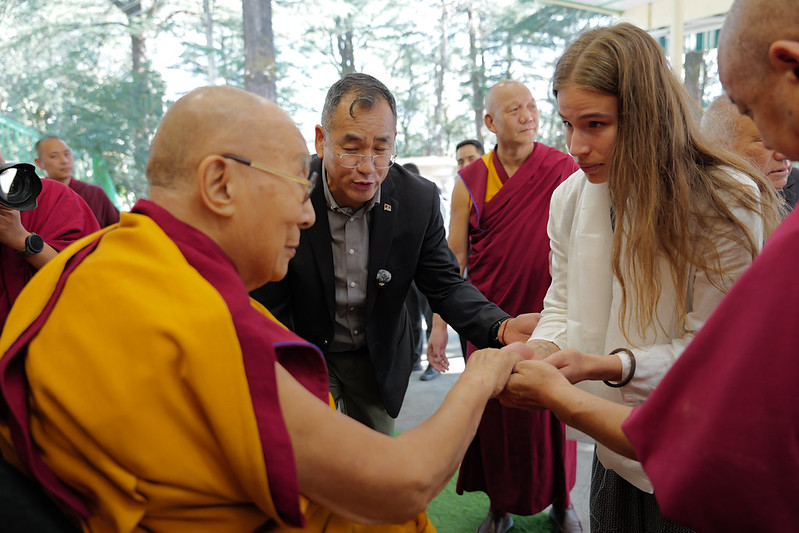
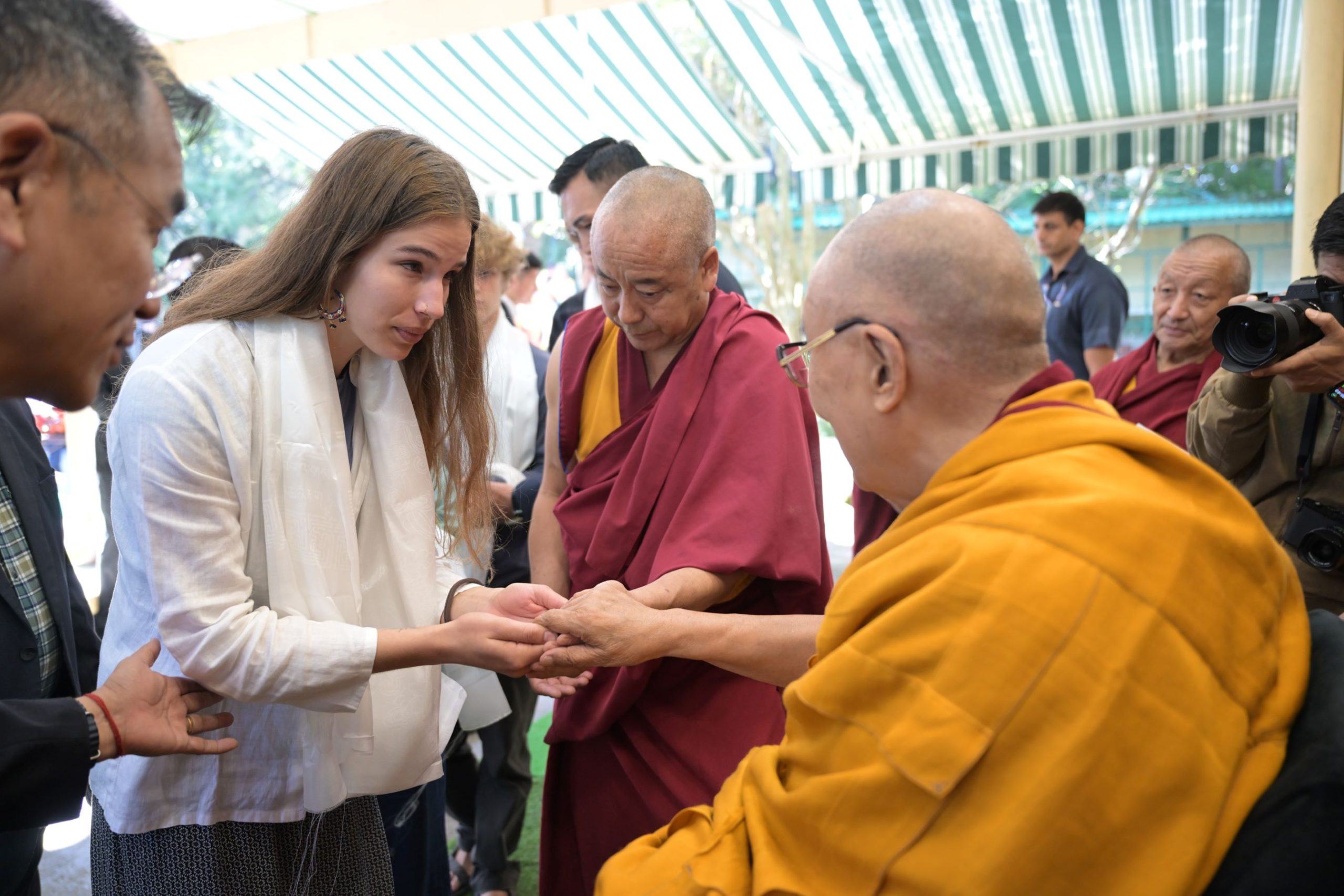
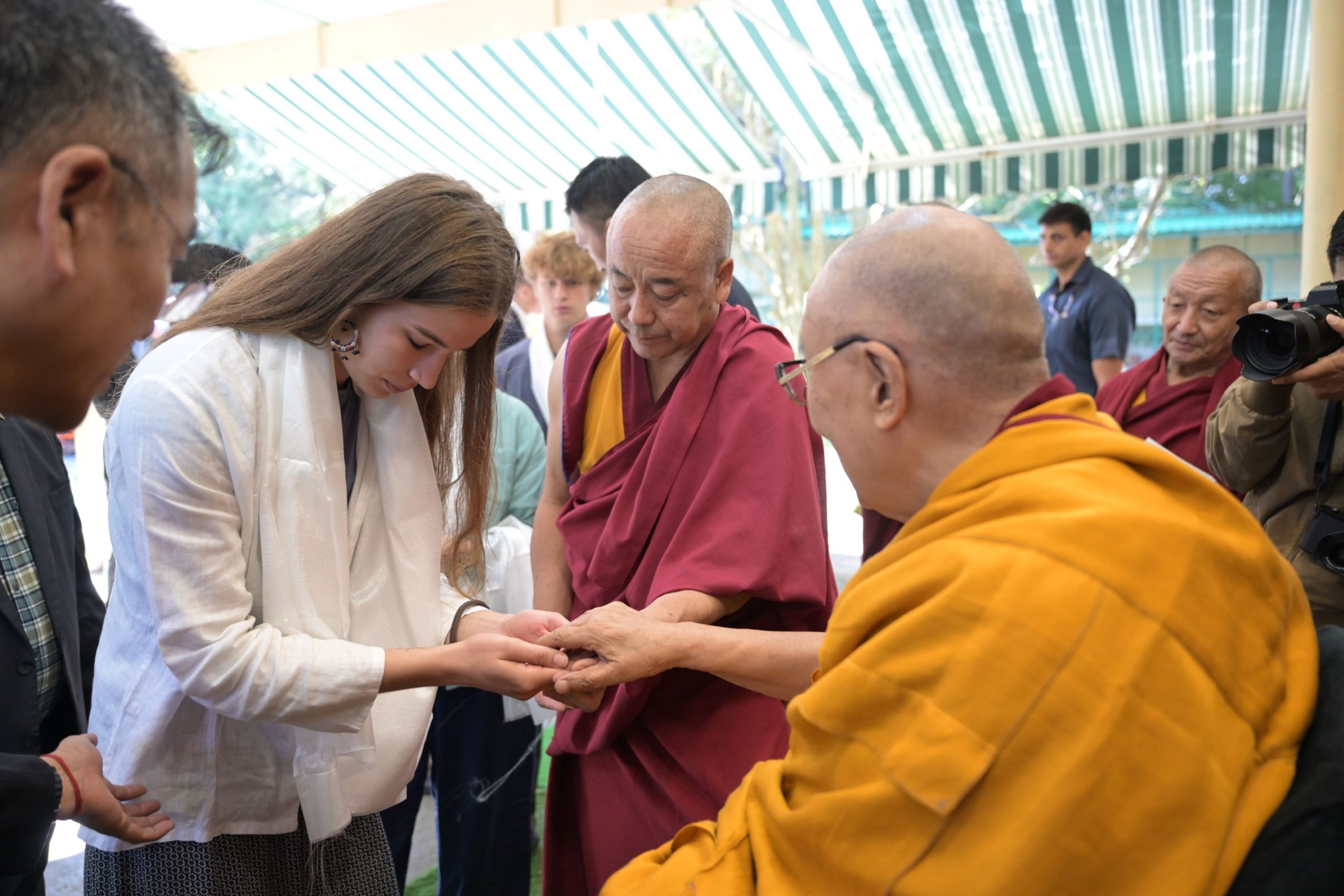
Instead of emerging from the room behind the chair as I’d imagined, the Dalai Lama rode out in a long golf cart accompanied by more monks and men in suits. Someone held his arm up at the elbow to support him as he waved to his audience. He was assisted to the chair. I thought he was going to speak, but instead the men surrounding him succinctly formed the audience into a line and the receiving of his blessings commenced.
As I moved closer to the front of the line, one of the monks took the envelope to be added to a pile and unfolded my white scarf and placed it around my shoulders. Then, before our group began going before His Holiness, someone announced that we were students from Eastern Mennonite University in Virginia. I was shown how to hold my hands to receive His blessing. I bowed my head as he touched my outstretched hands and bestowed his blessing upon me. I was told by a man with a big professional camera beside the Dalai Lama to look up for the picture. I was caught off guard and still chuckle when I see the awkward photo of that moment.
Afterwards, they handed us a large manila envelope containing a high quality picture of the Dalai Lama, two packets of blessed red kernels, a paper describing how to consume the holy seeds for health support, and a red string for tying around one’s wrist. And just like that it was over. We walked to a cafe, grabbed brunch and tea, visited the numerous now-open tourist shops that lined the temple’s entry road, and I bought key chains and knick-knacks galore.
After this visit, questions arose within me regarding the touristic manner in which I met His Holiness versus the religious or pilgrimage manner that others come with, like the sobbing woman in the audience. What does it mean to meet such a revered spiritual icon while not sharing in that same spirituality? What does it mean to receive His blessing, one of the highest honors in Tibetan Buddhism, as someone who before this trip only recognized his name, nay, his title? Despite these questions, meeting the Dalai Lama was one of the coolest opportunities I’ve ever received, and the experience will stick with me forever. I am so grateful to my professors for arranging such a deeply meaningful opportunity and pleasant stay in Dharamshala. And as I sit here in Tamil Nadu writing this blog post with sweat beading on my upper lip and neck, I am reminiscent of the time I got to spend in the Dharamshala “cold” weather.
-Ani Koontz